AppAgentix is an app development company for Cambridge spin-outs, campus companies and established firms. We plan your app in two weeks of discovery and try the screens with real users. Then we build it for iPhone and Android, launch it on both stores and look after it once it is live.
First versions for spin-outs in 9 to 10 weeks, discovery included
Your company holds the code and both store accounts
A working build on your phone each fortnight
Security and compliance
Cyber Essentials Certified
Cyber Essentials Plus Independently tested
ISO/IEC 27001:2022 Information security
ISO 9001:2015 Quality management
ISO/IEC 42001:2023 AI management
SOC 2 Type II Audited controls
UK GDPR and Data Protection Act 2018
ICO Registered
NHS DSPT Data security toolkit
WCAG 2.2 AA Accessibility
PCI DSS Card data security
What does a Cambridge app development company do for you?
It takes your idea from a sketch to an app people download and use. Discovery fixes the scope and one price. We design the screens and test them with users, then build the app and the server behind it. Every release is checked on real phones and published on Google Play and the App Store. After launch we fix faults and keep the app current.
First call
Free, 30 minutes
Price
Fixed after two weeks of discovery
Ownership
Code, designs and store accounts in your name
Refund
Undelivered scope refunded within 7 days
Cambridge
An app development company for Cambridge spin-outs and campus teams
We are an app development company working with Cambridge businesses. We build iPhone and Android apps for spin-outs, labs and growing firms, and our Cambridge representative meets you in person, usually within a day or two of your first message.
We can meet at your lab or at your office on a campus. A new enquiry gets an answer within 30 minutes, and the first consultation is free.
Much of our mobile app development here starts further along than an idea: a research result, a device prototype or a study protocol. We turn that into screens a participant, a clinician or a customer can use, and we write the scope so an investor or a funder can follow it.
Health and study apps hold special category data under UK GDPR. Discovery therefore ends with a data map: where each item is stored, who can see it and how long it is kept. The filled one for the study app is further down.
Everything we make sits in your company’s name from the first commit: the code, the design files, the store accounts and any AI prompts. For a spin-out, that keeps ownership clear when investors look closely.
Apps for iPhone and Android. One shared Flutter or React Native codebase usually costs less than two separate apps, and Swift or Kotlin comes in when a feature needs the phone’s own hardware.
In Cambridge
A study app for a campus company: consent screens with the participant’s own copy, a photo symptom diary and reminders before each visit, priced line by line further down.
Shown here
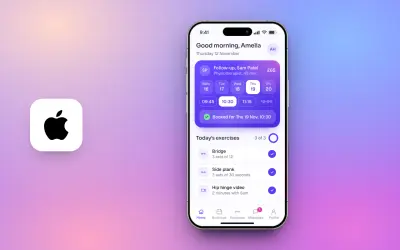
A patient app for a clinic, with a follow-up booked and the day’s exercises ticked off.
Everything behind the screens: the server, the stored data, sign-in, a panel where your staff manage people and records, and links to the tools your team already uses.
Built before
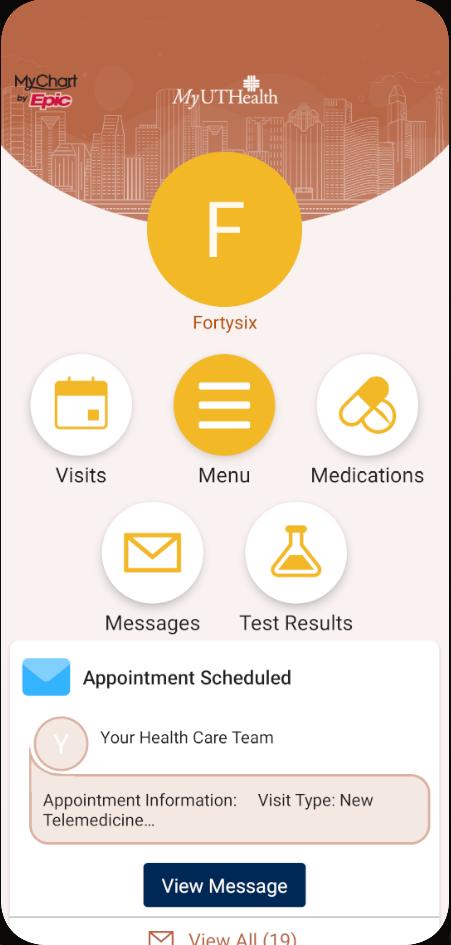
MyUTHealth, the patient portal we built, brings visit requests, test results and care-team messages together over HL7 FHIR APIs (the standard health systems use to share records) and Epic MyChart.
Shown here
A clinic calendar in the browser, filling with bookings made in the app.
App development for Cambridge life sciences, devices and spin-outs
01
Life sciences and studies
Participant apps with consent screens, symptom diaries and visit reminders, planned around the study protocol and the data map agreed in discovery.
02
NHS suppliers
Patient and clinician apps that sit beside MyChart, with answers to the NHS digital assessment form (DTAC) written from the finished build and any link to hospital records agreed with the trust first.
03
Chips, wireless and devices
Companion apps that set up, control and read data from a device, checked against each firmware version before a demo.
04
University spin-outs
A first version for early users and investors, with every asset in the new company’s name from the first commit.
05
AI and research teams
Search, summary or triage features added to a team’s existing app, tested on your own cases first.
06
Scale-ups
A second version shaped by what users did with the first, with developers who can join your own team.
Why Cambridge teams choose our app developers
2019the year we began building apps
Building apps since 2019
Our clients sit in over 11 countries, including the UK, and work in over 10 industries.
2app stores, each account held by your company
Both stores, under your accounts
We prepare and submit the store listings, and the app ships from your own Apple and Google Play accounts.
5users try the screens before we build
Screens tried before code
Five of your users try the prototype first; every release is then checked on real iPhones and Android phones, with a written test report.
10 minrecorded walkthrough with each build
A build every fortnight
Every second Friday a new build arrives on your phone, and the same named person answers your questions on working days.
20 to 40live apps we support at any one time
Care after launch
The first three months of fixes are inside the build price; support then covers fixes, updates for new phone systems and a monthly report.
95%+of our projects delivered on or before the agreed date
On time, at one price
Two weeks of discovery end in a scope, a clickable prototype and one fixed quote; any change is priced in writing first.
Apps another team started
A free first look checks the store accounts, whether the code builds and which libraries are out of date. A fixed-price review then marks each part to keep, repair or rebuild.
Your money back if we fall short
Any part of the written scope we fail to deliver is refunded to you within 7 days.
Planning an app for your Cambridge business? Talk it through with the developers who would build it, in a free 30-minute call.
Which Cambridge app development route fits your team?
Where does your app start?
Ifyou are a University spin-out (Cambridge Enterprise signed 121 commercial licences in 2024-25)
Choosea first version
A first version like the study app below runs 14 weeks, close to the length of the 12-week Accelerate Cambridge programme.
Ifyou are a life-science company on a campus such as the Biomedical Campus
Choosea participant or clinician app
See the study app below, built around consent screens and a photo diary, and the campus support routes further down.
Ifyou make chips or devices, like the 18 semiconductor firms with over 3,000 staff (2024)
Choosea companion app
It controls the device from the phone, like our smart home case.
Ifyou supply NHS hospitals, where Addenbrooke’s patients use MyChart on Epic
ChooseFHIR and Epic MyChart links
We draft the DTAC answers from the build.
App development in Cambridge for the Biomedical Campus hospitals
The Biomedical Campus holds three hospitals: Addenbrooke’s, the Rosie maternity hospital and Royal Papworth. More than 37,000 people visit the campus every day, according to the campus’s own figures.
Its eHospital programme completely transformed clinical areas in 2014, replacing the paper patient records the trust used to rely on. Patients see parts of their record through the MyChart app by choosing Cambridge University Hospitals when they sign in.
For a company selling into these hospitals, we design the app around what MyChart already shows, so patients do not meet the same record twice. Before any screen reads hospital data, we put the planned data flow to that hospital’s digital team for sign-off.
Chip, wireless and spin-out teams: what their apps need
A UK Government study in 2026 describes Cambridge as a globally leading semiconductor research and design ecosystem.
In our view, a chip or device team should have a companion app that shows the hardware working in a customer’s hands. We build it to the test plan of the device, so each firmware version is checked against the app before a demo.
For a spin-out, everything we make, from code and designs to store accounts, is in the new company’s name from the first commit. That keeps them clear of any later question about who owns what.
A Cambridge app development project in six steps
The standard plan runs 10 weeks; the study app runs 14, for consent screens, reminders and the study-system link.
The technology behind our Cambridge mobile app development
Discovery picks the tools for your app and for whoever runs it after us.
Flutter or React Native for both phones
Flutter
React Native
React
Expo
Flutter builds mobile, web and desktop apps from one codebase. React Native turns React code into native Android and iOS apps, with Expo taking care of builds, store launches and updates.
Swift and Kotlin for hardware-heavy apps
Swift
Kotlin
Swift is Apple’s language for all its platforms, and Google treats Android development as Kotlin-first. We use them when a companion app must work closely with a device.
Server, database and hosting
Node.js
PostgreSQL
AWS
A Node.js back end, a PostgreSQL database and AWS cloud hosting with a London region, which suits a study team that wants its data held in the UK.
Beta builds and error alerts
TestFlight
Sentry
TestFlight sends beta builds to your team or the public, and Sentry captures errors and alerts us with full context.
Three ways to pay for app development in Cambridge
The right model depends on how much of the app you can describe now.
Topic
How it works
Who it suits in Cambridge
Worth knowing
One fixed price
Discovery ends in one quote for the agreed scope, paid in milestones.
A campus company with a signed-off study protocol, or a firm replacing a paper process it knows well.
You know the budget before the build, and each change gets its own written price first.
Paying by the day
We bill the days worked, and the plan can change after any two-week sprint.
A spin-out still learning what early users want from the product.
With a new build on your phone every fortnight, you can redirect the work between sprints.
Developers in your team
Our app developers join your team and take their tasks from your own board.
A scale-up whose product lead needs mobile or device skills for a period.
Your hires inherit code and store accounts already held in your name.
How a diary entry reaches the study team
The study app priced further down, from the participant’s phone to the study team’s panel.
01Participant logs a symptom
Photo and note saved in the app as the participant enters them
02Sent on signal
The entry goes to the study system through the one agreed link
03Study team reviews
Only staff on that study see it in the panel
04Next visit reminder
The participant is reminded at the time set for the study
Apps we have built that fit Cambridge’s sectors
These are a few examples from the many apps we have built, picked for Cambridge health and device firms. Addenbrooke’s patients use MyChart on Epic, the system our patient portal runs on.
9:41
Healthcare
MyUTHealth
4.4stars from 750+ reviews and over 50,000 Google Play downloads
What we built
Patients were juggling separate ways to book, check results and reach their care team. Our portal app brings visit requests, test results, prescription refills, care-team messages and Google Fit together and runs on Android, over HL7 FHIR APIs and Epic MyChart.
Bedroom27°C now · humidity 58% · cooling for 14 min
On
Set to24°Cool · medium fan
Mode
CoolDryFanAuto
Fan speed
LowMediumHighSwingSleep
Turn off at 06:30Mon to Fri · next tomorrow
Connected devices
Digilite
1,000+Google Play downloads, rated 4.9 stars by verified reviewers
What we built
Families kept losing remotes, so in our smart home app, owners schedule appliances, run TVs and air conditioners by infrared, set routines and watch live energy use. It talks to Zigbee and Wi-Fi devices and sends infrared to older appliances, with a Kotlin Android app and a Node.js backend.
“Our patients needed the portal in their pocket: requesting visits, reading test results, reordering medicines and messaging their care team. AppAgentix built the Android app on our Epic MyChart system, careful where it matters: secure sign-in, no clinical detail on the lock screen, and patients choose what fitness data they share. The app has passed 50,000 downloads with 4.4 stars from over 750 reviews, and every release was tested before it reached our patients.”
“A smart home app only works if the whole family trusts it. AppAgentix built our Android app so every appliance and routine sits in one place, with each family member given the right access. Commands reach the device in a moment, the app shows honestly when something is offline, and voice control works through Google Assistant and Alexa. The listing holds a 4.9 star rating. Every release was tested on real devices in real homes.”
“We wanted one streaming service that felt the same on phone, tablet and TV, whether people watch free with adverts, subscribe or rent a film. AppAgentix built the apps for iPhone, iPad, Android and Apple TV and the service behind them. They got the hard parts right: playback that starts quickly, a home screen that works with a TV remote, and billing that stays correct. The Android app has passed 50,000 downloads.”
Support a Cambridge founder can use alongside the app build
Each of these programmes can lower what a founder or firm spends around the app build, through a venture programme, early funding or free advice.
Topic
Who runs it
What it offers
Who it is for
Status (16 November 2026)
Accelerate Cambridge
Cambridge Judge Business School’s Entrepreneurship Centre
A 12-week venture development programme
Founders in software, deep tech, biotech, medtech and other sectors
Taking applications for the spring 2027 programme
Accelerate@Babraham
Babraham Research Campus
A 10-month pre-seed programme with £10,000 of undiluted funding and communal lab space
Pre-seed companies on a life science campus
Listed as the campus’s early-stage programme
Cambridgeshire and Peterborough Growth Hub
The Growth Hub, fully funded by the UK Government
Free guidance, training and support, and a guide to finance and funding
Businesses across Cambridgeshire and Peterborough
Open; its support is free
Cambridge Enterprise Technology Fund
Cambridge Enterprise, the University’s innovation arm
Early-stage funding; over £4 million invested in 40 projects since it launched in 2023
New ventures based on Cambridge research
Investing, as the University reports
Where an application asks for a project plan, you can attach the scope from our discovery. Places and awards are decided by each programme, never by us, so read its own page before applying.
How much would it cost to have someone develop an app?
An imaginary study app for a Biomedical Campus company. It has consent, a photo symptom diary, reminders and two-step login on both phones, plus a study-team panel and a study-system link.
Worked example, excluding VAT
DiscoveryWeeks 1 to 2: scope and fixed quote£4,000
Consent and diary screen designWeeks 2 to 4: consent and diary screens+ £4,500
Four two-week build sprintsWeeks 4 to 12: a build after each+ £21,000
Phone testing and store launchWeeks 12 to 14: both stores, your accounts+ £3,500
Fixed price for the study app, 14 weeks= £33,000
Excludes VAT, and the 14 weeks are followed by three months of fixes at no charge. The study app launches on both stores, so the campus company holds its own Apple and Google developer accounts, whose fees sit with the running costs on our cost page. In the calculator, the defaults plus reminders and the panel show this app’s range. An example, not a client result.
Estimate your Cambridge app development cost
Pick what your study app needs.
Included to start: Discovery, design, the participant journey, consent screens, alerts and store release. 9 to 10 weeks.
Rules to screens
How UK rules change the screens of a study app
RuleScreen
01RuleUK GDPR Article 9: health data is a special category
ScreenEach health question says why it is asked
Nothing is collected first.
02RuleHRA and MHRA eConsent statement
ScreenConsent screens with the participant’s own copy
03RuleMHRA guidance on apps as medical devices
ScreenA written test in discovery of what the output is used for
04RuleNHS DTAC, updated form in full use by 6 April 2026
ScreenDTAC answers drafted from the build
For NHS buyers.
05RuleWCAG 2.2 AA
ScreenLarger text and clear contrast on every screen
06RuleData protection fee to the Information Commissioner
ScreenA launch checklist line, not a screen
Payable unless exempt.
Test report
What a Cambridge app development test report looks like
ExampleRelease test report, study app, build 1.0.0AppAgentix
Check
Device
Result
Notes
Participant gets a consent copy
iPhone 15
Pass
PDF opens from the profile
Diary photo on a weak signal
Galaxy S24
Pass after fix
Upload stalled; retry added in this build
Two-step code at sign-in
Pixel 8
Pass
Code works once, then expires
Reminder at the set time
iPhone 15
Open
Late on battery saver; fix booked for 1.0.1
Panel hides other studies
Galaxy S24
Pass
Staff see only their own study
An example for a study app, not a client result.
Data map
A filled data map for the study app
Discovery ends with this map for the study app, so the campus company and its study team agree where each item lives before any screen is built.
ExampleData map, participant study app, version 1.0AppAgentix
Data item
Where it is stored
Who can see it
How long it is kept
Name and email for sign-in
The study app’s own account store, in the UK
The participant and the study team
As set in the study protocol
Consent form version and date
Linked to the study system
The study team and the monitor
For the life of the study record
Symptom diary entries
Sent to the study system as each entry is saved
The study team for that study only
As set in the study protocol
Diary photos
Encrypted on the phone until sent, then deleted from the phone
The study team for that study only
As set in the study protocol
Reminder times
On the phone only
The participant
Until the participant leaves the study
An example for an imaginary study, not a client record. The real map follows your protocol and your data protection officer’s advice.
Not sure what your app would cost? Get scope, timeline and a price range in writing within two working days.
How much does it cost to build an app for a business?
It depends on the journeys, the phones and the systems it must link to. The study app on this page, with consent screens, a photo diary, reminders and a study-system link on both phones, is £33,000 fixed over 14 weeks before VAT. The estimator prices your own mix, and discovery then sets one fixed price.
Who can I pay to build an app?
Three kinds of team: a freelancer, an agency or your own hires. A freelancer suits a founder who can manage the build every day. An agency like ours brings design, building, phone testing and the store launch under one fixed price. Your own team pays off once the app changes every week, year after year.
What is IoT app development?
It is building the phone app that sets up, controls and reads data from a connected device, plus the server between them. In Digilite, the smart home app we built, owners schedule appliances and watch live energy use, and the app talks to Zigbee and Wi-Fi devices. We check each firmware version against the app before a demo.
Is software considered intellectual property?
Yes. UK copyright law protects a computer program as a literary work. Its author is the first owner, unless it was written by an employee at work, when the employer is. An outside developer therefore keeps the copyright unless it is assigned, which is why we put the code, designs and store accounts in your company’s name from the first commit.
Most app projects run late. Let’s make yours the one that ships.
More than 95% of our projects are delivered on or before the agreed date. About 60% of our clients come back for a second project.
What happens next
1We reply within 30 minutesEvery day of the year. A developer at our app development company, not a sales team, reads your brief.
2A 30-minute callWe ask about users, deadlines and the systems you already run.
3A written view in two working daysScope, timeline and a price range, yours to keep.
Thank you. Your brief is in.
A developer, not a sales team, reads it. We reply within 30 minutes, from info@appagentix.co.uk.
We use cookies to run this site and, with your permission, to understand how it is used. Cookie policy · Privacy policy
Most app projects run late. Let’s make yours the one that ships.
More than 95% of our projects are delivered on or before the agreed date. About 60% of our clients come back for a second project.
What happens next
1We reply within 30 minutesEvery day of the year. A developer at our app development company, not a sales team, reads your brief.
2A 30-minute callWe ask about users, deadlines and the systems you already run.
3A written view in two working daysScope, timeline and a price range, yours to keep.
We wanted one streaming service that felt the same on phone, tablet and TV, whether people watch free with adverts, subscribe or rent a film. AppAgentix built the apps for iPhone, iPad, Android and Apple TV and the service behind them. They got the hard parts right: playback that starts quickly, a home screen that works with a TV remote, and billing that stays correct. The Android app has passed 50,000 downloads.
Michael S.CEO and Co-Founder, Play Now Media
Thank you. Your brief is in.
A developer, not a sales team, reads it. We reply within 30 minutes, from info@appagentix.co.uk.

 WCAG 2.2 AA Accessibility

 Flutter
 React Native
 Expo
 Swift
 Kotlin
 Node.js
 PostgreSQL
 AWS
 TestFlight
 Sentry
 Healthcare

 MVP developmentA first version for users and investors.
 iOS app developmentNative Swift apps for iPhone and iPad.
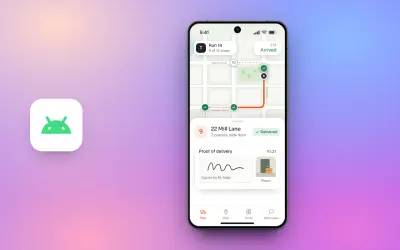 Android app developmentNative Kotlin apps for Google Play.
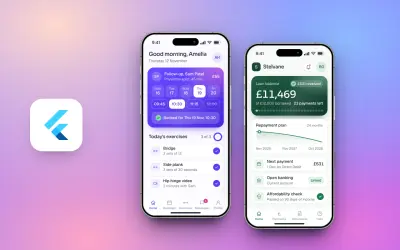 Flutter app developmentOne Flutter codebase for iOS and Android.
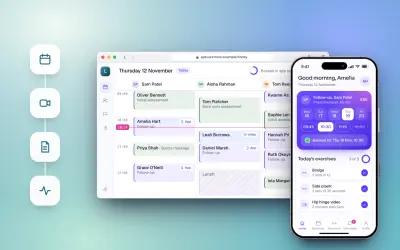 HealthcarePatient, clinic and care apps.
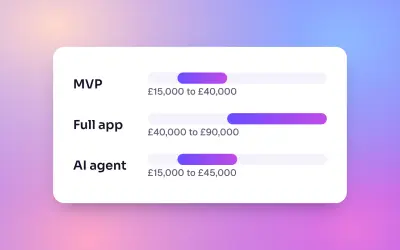 PricingWhat apps and AI agents cost, in pounds.
 LondonMobile apps for London businesses.
 ManchesterMobile apps for Manchester businesses.
 BristolMobile apps for Bristol businesses.
 EdinburghMobile apps for Edinburgh businesses.
 BirminghamMobile apps for Birmingham businesses.
 LeedsMobile apps for Leeds businesses.