Fintech app development company for UK teams, built around the rules.
Planning a payments, lending, banking or wealth app for the UK market? Our fintech app development maps the regulation before the first screen is drawn, then builds to one fixed price. Each price is in pounds, each MVP plan is counted in weeks, and the code stays yours.
APP fraud reimbursementPayment firms using Faster Payments or CHAPS
Open Banking and PSD2Banks and other payment service providers, including account information and payment initiation providers
Security and compliance
Cyber EssentialsCertified
Cyber Essentials PlusIndependently tested
ISO/IEC 27001:2022Information security
ISO 9001:2015Quality management
ISO/IEC 42001:2023AI management
SOC 2 Type IIAudited controls
UK GDPR andData Protection Act 2018
ICORegistered
NHS DSPTData security toolkit
WCAG 2.2 AAAccessibility
PCI DSSCard data security
What does UK fintech app development involve?
A fintech app is a normal app with a regulator attached, so we start with a two-week discovery. It maps your product to the FCA permission it needs, for your adviser to confirm. The MVP plan runs 12 to 16 weeks, discovery included, at one fixed price set in discovery. Authorisation fees, audits and per-check provider costs are separate and named in the price section.
Discovery
2 weeks, ends in a fixed quote
Fintech MVP
12 to 16 weeks
Full app
5 to 9 months
Support
Monthly fixes and monitoring
Fintech app development by product type
Six kinds of money product, each with what we hand over and what must be true before it is worth building.
01
Payments and wallets
Payments
Pay-by-bank, card acceptance, peer payments and stored balances each raise the permission question first. The FCA permission or registration you need depends on what the product does, for example initiating payments or issuing e-money, and discovery settles it in writing. You receive a one-page permissions map in week 2. Card payments made up 64 per cent of all UK payments in 2025 (UK Finance Payment Markets Report 2025).
02
Lending and credit apps
Credit
A lending build covers the application, affordability checks with Open Banking data, decisioning rules and repayment screens. Consumer credit has its own FCA rules, so the loan flow is built from the rulebook, not from a template. Every decision rule is stored as an editable setting, never hard-coded.
03
Digital banking front ends
Banking
Account views, transfers and card controls sit on top of a banking partner. We build the app and the integration, while your partner holds the licence and the ledger. The partner API is wrapped behind one layer, so you can swap partners later. An older core system with no API adds time, which is priced in discovery. In 2024, 14% of UK adults had a current account with a digital bank, up from 11% in 2022 (FCA Financial Lives 2024).
04
Wealth and investing
Wealth
A wealth build covers onboarding, suitability questions, portfolio views and statements. Whether the product gives advice or arranges deals is a question for your regulatory adviser, answered before any build. Risk warnings and disclosures are content files your compliance lead can edit.
05
Back-office and operations tools
Operations
Case queues for fraud and complaints, reconciliation screens and audit trails are often a smaller first project, because the users are your own staff. Each fraud or complaint case keeps a log of which staff member acted, what they changed and when.
06
Open banking app development
Open Banking
Account data and payment initiation run through a regulated provider, with consent screens and renewal reminders built in. Consent expiry dates are tracked per customer and shown in the admin panel. Open banking reached 16.5 million user connections by December 2025, up from 12.1 million a year earlier (Open Banking Limited).
Building in fintech means rules you cannot get wrong. Talk them through with the developers who would build to them.
Which permission you need is for your adviser or the FCA to confirm; we build software and are not a law firm or regulated firm. Each date and limit below is taken from the FCA, PSR, ICO or PCI Council, as of November 2026.
FCA permission
Applies to
Payment, e-money and consumer credit firms
What it changes in the build
In discovery we write the product description your adviser needs for the application. Providing payment initiation services requires FCA authorisation, and account information only services can use a lighter registration (FCA, Account information and payment initiation services page). For new payment and e-money institutions, the FCA states standard timescales of 3 months from a complete application and 12 months from an incomplete one.
Consumer Duty
Applies to
FCA-regulated firms serving retail customers
What it changes in the build
Plain-English screens, visible fees and a help route that works. Key journeys are tested with five real users before development starts. The Duty applies from 31 July 2023 for open products and 31 July 2024 for closed ones (FCA policy statement PS22/9). Its four outcomes are products and services, price and value, consumer understanding and consumer support.
APP fraud reimbursement
Applies to
Payment firms using Faster Payments or CHAPS
What it changes in the build
Payment screens include a warning step and an evidence log you can export. Since 7 October 2024 payment firms must reimburse individuals, microenterprises and charities hit by authorised push payment fraud on Faster Payments and CHAPS (Payment Systems Regulator). The limit is £85,000 per claim as of November 2026. Reimbursement is expected within 5 business days, with an outcome within 35 business days if the firm needs more information. This affects how you warn customers, hold risky payments and log evidence. APP fraud losses rose 19 per cent to £576.4 million in 2025 (UK Finance Annual Fraud Report 2026).
Open Banking and PSD2
Applies to
Banks and other payment service providers, including account information and payment initiation providers
What it changes in the build
The consent flow and its renewal reminder are part of the MVP, not an extra. The UK keeps these rules in the Payment Services Regulations 2017, and strong customer authentication has applied to account access and payments since 14 September 2019. Where the bank uses the relevant exemption, third-party providers showing account information must get explicit consent at least every 90 days (FCA, as of November 2026).
UK GDPR and the ICO
Applies to
Organisations that use personal information
What it changes in the build
You receive a data map of every field we store and where it is held. A money app handles customers’ personal information, so you need a valid lawful basis, documented before you use it (ICO guidance). You also need a way to answer subject access requests, and organisations that use personal information pay the ICO data protection fee unless exempt (ICO).
PCI DSS
Applies to
Card payments, to the extent your payment provider confirms
What it changes in the build
Card entry is built on your payment provider’s hosted fields. PCI DSS is published by the PCI Security Standards Council, and your payment provider can tell you which parts apply to you. Version 4.0 was retired on 31 December 2024 and the new requirements took effect on 31 March 2025.
“Drivers want three things: find a working charger, start charging without fuss and pay without surprises. AppAgentix built the Android app, the prepaid wallet and the link to our chargers. Live charger status is accurate, starting a session is a scan and a tap, and the wallet settles the right amount even if the connection drops. The app has passed 10,000 downloads with a 4.1 star rating, and our manual billing work has dropped sharply.”
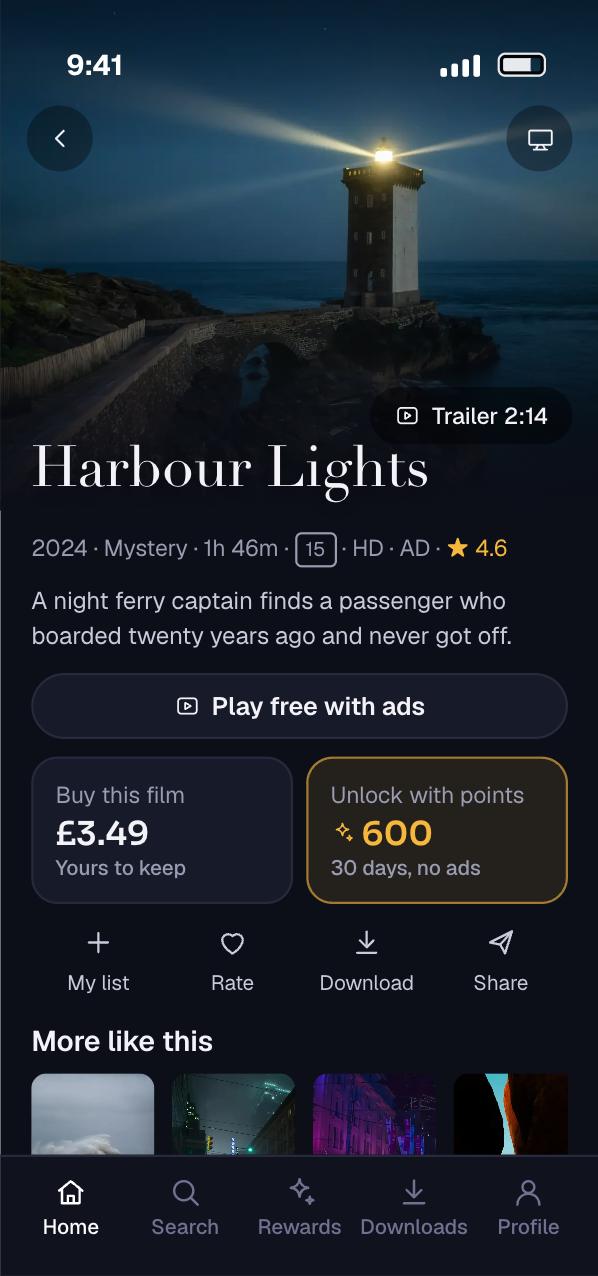
“We wanted one streaming service that felt the same on phone, tablet and TV, whether people watch free with adverts, subscribe or rent a film. AppAgentix built the apps for iPhone, iPad, Android and Apple TV and the service behind them. They got the hard parts right: playback that starts quickly, a home screen that works with a TV remote, and billing that stays correct. The Android app has passed 50,000 downloads.”
“Our patients needed the portal in their pocket: requesting visits, reading test results, reordering medicines and messaging their care team. AppAgentix built the Android app on our Epic MyChart system, careful where it matters: secure sign-in, no clinical detail on the lock screen, and patients choose what fitness data they share. The app has passed 50,000 downloads with 4.4 stars from over 750 reviews, and every release was tested before it reached our patients.”
We have been building apps since 2019. A few examples from the many apps we have built where people hold a balance, pay or subscribe inside the app. A regulated money product goes further and starts with the permissions step below.
EV charging
Tiger Charge: charging app with a prepaid balance
What we built
We built Tiger Charge for a charging network whose drivers pay from a balance topped up in advance. On one map they check each station’s live charger status and plug types, then scan a charger to start or stop a session. Under those screens sit a Kotlin Android app, a Node.js backend, OCPP links to the chargers and Google Maps Platform.
Manual billing work fell by 70%, and over 40% of charging sessions begin in the app with no call to support.
Streaming service app: plans, one-off buys and a points balance
What we built
For this streaming service app we built several ways to pay for viewing under one account. A viewer can watch free with ads, choose a plan and manage its renewals, or buy a single film or series. A points wallet holds what each viewer earns through eligible activity, ready to spend on a chosen title or a spell of premium access. Card payments run through secure payment gateway APIs, behind a Flutter app with a Node.js backend and MongoDB.
One account can pay by plan, buy a single title or spend earned points, so viewers who never subscribe still have a route to premium viewing.
Pick the route before you pick a budget, because it sets the ledger, the reporting screens and the launch date.
Topic
Own authorisation
Banking or payments partner
Principal firm arrangement
Who holds the licence
You
Your partner
The principal firm you act under
Typical start
After the FCA decides: 3 months from a complete application for a payments or e-money firm, up to 12 if incomplete
Once the partner onboards you
30 days’ FCA notice for an appointed representative, up to 2 months for a payments agent
Control over product
Full
Within partner rules
Under the principal’s oversight
Build impact
Own ledger, safeguarding and reporting screens
Integration layer plus your front end
Front end plus principal reporting
Wrong choice when
You only need a pilot with 100 users
You need your own pricing model
You need full control of the product
The figures are FCA timescales as of November 2026 and exclude the time to prepare an application. Your regulatory adviser should confirm the route before any build starts.
What does a permissions map look like?
A filled example for an imaginary pay-by-bank wallet. Yours is written in discovery.
Pass after fix: the first draft named the app company
Send money to a friend
A payment service, type not settled
Not decided
Open: the adviser answers in week 2, and this screen waits
An example, not a client record. Nothing on an open row is built until it is answered.
How do we keep money data safe?
Four practices are written into every fintech quote, and each is something you can check in a diagram, a log or a report.
01
Card data
Card entry uses your payment provider’s hosted fields, so card numbers never reach our servers or your database.
The architecture diagram shows every place card data goes.
02
Secret keys
API keys and signing secrets sit in your own secrets manager, never in the code or on a developer laptop.
Access is granted per person, and you can remove ours in one step.
03
Staff actions
The admin panel records who viewed or changed a customer record, what changed and when it happened.
The log exports as a file for an audit or a complaint case.
04
Security tests
Automated security tests run on every build, and before launch an independent penetration tester you hire from a CREST-accredited firm attacks the app.
You receive the report, and we fix the findings in what we built.
Where does the card number go?
01Customer’s phone
The card form is your payment provider’s hosted field.
02Payment provider
Receives the card number directly and returns a token.
03Your backend
Stores the token and the payment status only.
How do we test AI inside a regulated app?
AI is optional, so we only add it where it saves staff time, and we write down how it was tested.
01
Your cases, not ours
Document reading, fraud triage or support answers are run against your own historic cases before launch, and you read the full results, including every miss.
02
A human stays in the loop
Credit decisions and account closures are never made by a model alone: the model suggests, shows the evidence it used, and a named person decides.
03
Running cost on the quote
Each model call has a price, so the quote gives a monthly figure for your fraud or support volume, and the monthly report checks it.
An Open Banking consent, step by step
The customer stays in control of what is shared.
01Choose your bank
02See what is shared
03Approve in your bank app
04Connected
05Renew or revoke
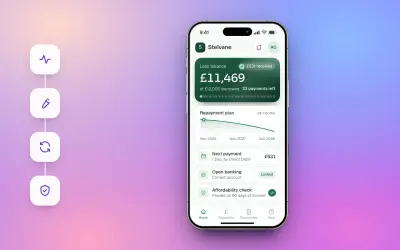
9:41
SStelvaneRO
Loan balance£531 received
£12,000£11,469
of £12,000 borrowed24 payments left23 payments left
Repayment plan24 months
Nov 2026Nov 2027Oct 2028
Next payment1 Dec, by Direct Debit
£531
Open bankingCurrent account
Linked
Affordability checkChecking 90 days of incomePassed on 90 days of income
HomePaymentsDocumentsHelp
When is custom fintech app development the wrong choice?
If a licensed platform already does the job, use it.
If a licensed platform already does the job, use it. For a new money product, 50 pilot customers, a payment link and a spreadsheet often show whether people want it, before an MVP is worth paying for.
If you cannot yet say which FCA permission you need, do discovery first. Building before that question is answered risks a rebuild, because the licence route decides the ledger, the reporting screens and the integrations.
Need a price before you go to the board? A two-week discovery ends in one fixed figure, and you own the code from the first commit.
A typical fintech MVP takes 16 weeks with discovery included, and a product with one money flow and a ready partner can finish in 12. Authorisation, if you need it, runs in parallel and does not shorten this plan. More than 95% of our projects are delivered on or before the agreed date.
Week12345678910111213141516monthly
01Discovery and rules map
02Design and user tests
03Core build
04Security testing
05Store submission
06Run and improve
01Weeks 1 to 2
Discovery and rules map
We map the product to the rules above, list the integrations, choose native, Flutter or React Native, and write the scope behind the fixed quote.
You receive: The permissions map your adviser checks, plus the scope, a clickable prototype and the fixed quote.
02Weeks 3 to 4
Design and user tests
Onboarding, payment and error screens are designed, then tested with five real users.
You receive: Onboarding and payment screens tried by five users, plus a WCAG 2.2 AA accessibility checklist.
03Weeks 5 to 12
Core build
Four two-week sprints cover sign-up and identity checks, the money flow, the admin tools and the provider integrations.
You receive: A new build on your phone at the end of each of the four sprints.
04Weeks 13 to 14
Security testing
We run automated tests, fix what they find and brief the independent tester that you hire.
You receive: The security test report, with each finding on a fix list and an owner beside it.
05Weeks 15 to 16
Store submission
Apple’s guideline 3.2.1(viii) says trading, investing and money management apps should be submitted by the financial institution that provides the service. Google Play has its own Financial Services policy, so we prepare both listings and answer reviewer questions.
You receive: Live store listings under your own developer accounts.
06Monthly
Run and improve
The first 3 months of fixes are in the build price, then optional support covers crashes, failed payments and operating system updates.
You receive: A monthly report on failed payments, crashes and running costs across your money flows.
How much does a fintech app cost?
Each line says what it includes and how long it takes. Price your own version with the calculator below.
01
Discovery
2 weeks
Permissions map, scope, prototype and fixed quote. Deducted from the build if you continue.
02
Fintech MVP development
12 to 16 weeks
One app on iOS and Android, sign-up, identity check integration, one money flow, admin panel and store launch.
03
Full app
5 to 9 months
Several money flows, more integrations, analytics, reporting exports and accessibility to WCAG 2.2 AA.
04
AI feature, one workflow
quoted per feature
For example document reading for loan applications or a fraud triage queue, tested on your own cases.
05
Support and running
monthly
Fixes, operating system updates, monitoring and the monthly report.
Three things move the price most: the number of money flows, the integrations and the licence route. A banking front end on a licensed partner sits in the MVP or full app range. A neobank with its own licence and ledger is a larger programme, quoted after discovery. Discovery turns the permissions map and agreed scope into one fixed figure. If that scope is not delivered by the agreed date, we keep working at no extra charge until it is. Some costs are paid to other parties and are not in the price: FCA application fees, adviser time, the independent penetration test and any PCI DSS assessment. The same goes for per-check provider fees, partner charges, hosting at cost and your own compliance lead. Full rates are on our app development cost page.
Estimate your fintech app in a minute
Choose the phones, identity checks and money flows, and the range moves with each choice.
Included to start: Discovery, rules map, design, the core app, security testing and store launch. 10 to 12 weeks.
Who owns the code, the accounts and the keys?
You do, and it is written into the contract, however you work with us.
Source code
Your repository holds every commit from day one, and payment transfers the licence to you.
Accounts
Your company name is on the Apple, Google and cloud accounts from the start, and we join only as invited users.
API keys
Payment and identity-check provider keys stay in your secrets manager, and one step removes our access.
Data
Stays in UK or EU regions that you choose in discovery, with the region written on the quote.
Handover
A runbook, an architecture diagram and a recorded walkthrough let another team take over the app.
Working model
Choose a fixed price build after discovery, or add our engineers to your own team at a day rate.
Three ways to work with us
Pick by how much you can write down today. Prices in pounds, excluding VAT.
Fixed-price build
Best whenYou can say what the product must do, and want one figure before work starts.
Price
MVP from £15,000, 8 to 14 weeks
Two weeks of discovery first, its fee taken off the build price
Full iPhone and Android app in 4 to 8 months
Terms
One fixed figure in writing after discovery
Fixes for 90 days after launch included
If we do not deliver what the written scope promises, we refund what you paid for the undelivered work within 7 days.
You own the code, designs and accounts from the first commit.
The ten questions discovery starts with: users, the jobs they need done, systems to connect, rules, deadline and budget. Fill it in, attach nothing else, and the first call starts at the right place.
A UK fintech MVP with us starts from £40,000 excluding VAT, and a full app costs more. Discovery comes off the build price, while regulatory fees, penetration testing and per-check provider charges are extra.
How much does it cost to create a banking app?
A banking app on a licensed banking partner fits our MVP range as a first version. A full app with several money flows sits in our full app range. Your partner holds the licence and sets its own fees.
How much does it cost to develop a neobank app?
A neobank front end on a licensed partner sits in our full app range. A neobank with its own licence and ledger is a larger programme, quoted after discovery.
What is a fintech bank?
In our view, the closest FCA term is a digital bank, which its Financial Lives 2024 report defines as an institution that offers financial services solely through a digital platform. In that survey, 14% had a current account with a digital bank in 2024, up from 11% in 2022. A new fintech can launch on a licensed banking partner, which holds the licence and the ledger while we build the app.
How do I build a FinTech app?
Start with the permission, not the screens: work out which FCA permission the product needs, or which licensed partner will hold it. Then scope one money flow, test the key screens with real users and build in two-week sprints, with security testing before launch.
What is fintech in software development?
In our work, it is software for payments, lending, banking or wealth, where we map the UK regulation before the first screen is drawn. Our six fintech product types run from payments and wallets to lending, banking front ends, wealth, operations tools and open banking. With us, each starts with a permissions map in week 2 for your adviser to check, and nothing on an open row is built until it is answered.
Is open banking secure?
Open Banking is regulated by the FCA and runs on the customer’s explicit consent, though no system removes fraud entirely. Firms that initiate payments must be authorised by the FCA, and firms that only provide account information can register instead. Strong customer authentication has applied to account access and payments since 14 September 2019 (FCA).
Why is fintech risky?
Fintech is risky because apps handle real money and personal data, and UK rules make firms pay for some failures. Since 7 October 2024, payment firms must reimburse individuals, microenterprises and charities for authorised push payment fraud, up to £85,000 a claim. So we keep card numbers off your servers, log every staff action and have an independent tester attack the app.
How to start a P2P lending platform?
Start with the regulatory question, because a platform that matches lenders with borrowers handles credit and other people’s money. Ask a regulatory adviser which FCA permission your model needs before you scope any software. Then build one loan journey first, from application and affordability checks to decision rules and repayments.
Who are the best FinTech app developers?
There is no single best firm, and we do not rank other companies. Compare providers on four things you can check: a price in pounds, written code ownership, the UK rules they name and a built app you can open. Then ask each one what is not in the price.
Who are the top app developers in the UK?
No list settles it, and we do not rank other firms, so judge each one on what you can check. For a money app, ask which FCA route the firm would plan, and whether card numbers ever reach its servers. Ours never do, because card entry uses your payment provider’s hosted fields, shown on the architecture diagram.
Most app projects run late. Let’s make yours the one that ships.
More than 95% of our projects are delivered on or before the agreed date. About 60% of our clients come back for a second project.
What happens next
1We reply within 30 minutesEvery day of the year. A developer at our app development company, not a sales team, reads your brief.
2A 30-minute callWe ask about users, deadlines and the systems you already run.
3A written view in two working daysScope, timeline and a price range, yours to keep.
Thank you. Your brief is in.
A developer, not a sales team, reads it. We reply within 30 minutes, from info@appagentix.co.uk.
We use cookies to run this site and, with your permission, to understand how it is used. Cookie policy · Privacy policy
Most app projects run late. Let’s make yours the one that ships.
More than 95% of our projects are delivered on or before the agreed date. About 60% of our clients come back for a second project.
What happens next
1We reply within 30 minutesEvery day of the year. A developer at our app development company, not a sales team, reads your brief.
2A 30-minute callWe ask about users, deadlines and the systems you already run.
3A written view in two working daysScope, timeline and a price range, yours to keep.
We wanted one streaming service that felt the same on phone, tablet and TV, whether people watch free with adverts, subscribe or rent a film. AppAgentix built the apps for iPhone, iPad, Android and Apple TV and the service behind them. They got the hard parts right: playback that starts quickly, a home screen that works with a TV remote, and billing that stays correct. The Android app has passed 50,000 downloads.
Michael S.CEO and Co-Founder, Play Now Media
Thank you. Your brief is in.
A developer, not a sales team, reads it. We reply within 30 minutes, from info@appagentix.co.uk.
 WCAG 2.2 AAAccessibility

 SwiftGeneral-purpose language for all Apple platforms and servers
 SwiftUIDeclarative screens for every Apple platform
 KotlinGoogle’s preferred language for Android
 Jetpack ComposeAndroid’s current toolkit for screens
 FlutterMobile, web and desktop apps from one codebase
 React NativeNative Android and iOS apps built with React
 FigmaScreens and clickable prototypes you can test
 TypeScriptTyped JavaScript that catches errors early
 Node.jsJavaScript runtime for scalable network applications
 PythonLanguage for web development and scientific work
 PostgreSQLOpen-source database; pgvector adds vector search
 RedisIn-memory store for caching and live messages
 FirebaseFirestore and Realtime Database: store and sync app data
 AWSCloud hosting with a London region
 CloudflareContent delivery, caching and attack protection
 GitHub ActionsCI/CD platform to automate build, test and deployment
 SentryCaptures errors and alerts you with full context
 MVP developmentA first version for users and investors.
 iOS app developmentNative Swift apps for iPhone and iPad.
 Android app developmentNative Kotlin apps for Google Play.
 Flutter app developmentOne Flutter codebase for iOS and Android.
 React Native app developmentCross-platform apps written in React Native.
 Agentic AI developmentAI agents that complete tasks in your systems.
 Maintenance and supportUpdates, monitoring and OS releases.
 Hire mobile app developersiOS, Android and Flutter engineers for your team.
 InsuranceQuotes, claims and policy apps.
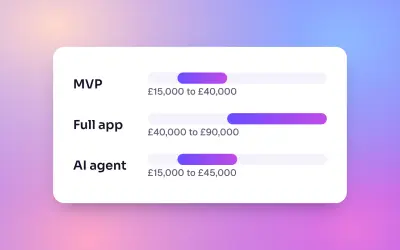 PricingWhat apps and AI agents cost, in pounds.
 AutomotiveDealer, service and driver apps.