Custom CRM development UK: bespoke CRM and ERP systems built for your firm.
We do custom CRM development: a CRM, a light ERP or both, built around how your firm works, with your data moved from spreadsheets and old tools. Below: our prices, a cost estimator, a licence sum and a filled scope.
Custom CRM first version in 8 to 14 weeks, at one fixed price after discovery
A one-page scope signed in week 2: roles, stages, fields and links
Every record counted in, loaded or rejected on a sheet you sign
Running costs listed line by line, billed to accounts in your name
crm.northgate.example/pipeline
Sales pipelineNovember 2026 · all ownersSearch contacts, deals, invoicesXero synced
Open pipeline£184,20014 deals
Won this month£42,600+18% on October
Quotes awaiting reply62 due today
Average days to win21was 34
Enquiry4£31,500
Hollis Joinery£6,200
Ruth Okoye
Call back today
Tarn Valley Dental£12,800
Sam Patel
Discovery call Thu
Quote sent3£48,900
Burrows Bakery£8,400
Leah Burrows
Quote QT-118, day 3
Marsh Valeting£14,500
Daniel Marsh
Chase Fri
Negotiation2£61,200
Lennox Florists£22,000
Sophie Lennox
Revised terms sent
Won5£42,600
Fernhill & Co£9,600
Tom Hughes
Invoice paid in Xero
Security and compliance
Cyber EssentialsCertified
Cyber Essentials PlusIndependently tested
ISO/IEC 27001:2022Information security
ISO 9001:2015Quality management
ISO/IEC 42001:2023AI management
SOC 2 Type IIAudited controls
UK GDPR andData Protection Act 2018
ICORegistered
NHS DSPTData security toolkit
WCAG 2.2 AAAccessibility
PCI DSSCard data security
How much does a custom CRM system cost?
A first version of a custom CRM costs £15,000 to £40,000 and takes 8 to 14 weeks. A CRM joined to ERP modules such as quotes, stock and invoicing takes 4 to 8 months. Discovery takes 2 weeks and its fee comes off the build price. All prices exclude VAT. For example, a first version for a 40-staff firm moving from an old CRM and two spreadsheets is a fixed £27,000. Price your own version with the calculator on this page.
CRM first version
8 to 14 weeks
Full CRM or CRM plus ERP modules
4 to 8 months
Discovery
2 weeks, fee taken off the build price
Support
monthly, 3-month minimum, then 30 days notice
What is custom CRM development?
A CRM holds your customers and sales steps; a light ERP runs the quotes, orders, stock and jobs behind them. In 2023, 61% of UK firms had adopted specialised software (ONS Management and Expectations Survey, 2023).
01
Pipeline stages written from your own sales steps
Your own stages, fields and approval rules, with a forecast from your deals.
Stages and fields go on the scope you sign in week 2.
02
One record per customer
Emails, call notes, quotes and support cases sit on one timeline. The clinic platform we built for a healthcare business keeps clinical notes, appointments and billing in one system with the patient records.
Every record shows who changed it and when.
03
Quotes, orders and invoices
A quote from your price list becomes an order, then reaches your accounts package by an automatic link.
Each link to another system is a named, priced line on the quote.
04
Bespoke ERP: stock, jobs and suppliers
Stock, purchase orders, job sheets and suppliers for a back office still run on spreadsheets.
We build only the modules listed on the quote.
One record, every team
A custom system joins the steps your tools keep apart.
01Enquiry
02Customer record
03Quote
04Invoice
05Reports
crm.northgate.example/pipeline
Sales pipelineNovember 2026 · all ownersSearch contacts, deals, invoicesXero synced
Open pipeline£184,20014 deals
Won this month£42,600+18% on October
Quotes awaiting reply62 due today
Average days to win21was 34
Enquiry4£31,500
Hollis Joinery£6,200
Ruth Okoye
Call back today
Tarn Valley Dental£12,800
Sam Patel
Discovery call Thu
Quote sent3£48,900
Burrows Bakery£8,400
Leah Burrows
Quote QT-118, day 3
Marsh Valeting£14,500
Daniel Marsh
Chase Fri
Negotiation2£61,200
Lennox Florists£22,000
Sophie Lennox
Revised terms sent
Won5£42,600
Fernhill & Co£9,600
Tom Hughes
Invoice paid in Xero
Which do you need: a CRM, an ERP module, or a ready-made tool?
Start from the problem, not the label.
What is going wrong today?
IfYour sales steps or pricing rules need workarounds in every standard tool
ChooseA custom CRM
Pipeline, records, roles and reports follow your rules, and a first version takes 8 to 14 weeks.
IfStaff retype each accepted quote into an order, then into an invoice
ChooseA CRM with quotes and invoices
One record carries the quote to the order and on to your accounts package.
IfStock levels, purchase orders or job sheets still live in spreadsheets
ChooseA CRM with ERP modules
Each module is a priced line on the quote; full builds take 4 to 8 months.
IfYou have under about ten users, or a standard pipeline already fits
ChooseA ready-made CRM
It is cheaper, and our discovery report says so in writing.
Is your team working around software that no longer fits the business? Tell us where it hurts and we will say what to build first.
When does a build cost less than licences? Run the sum
Users times the monthly fee times 12 gives the yearly bill. Divide the build price by the monthly bill to find when it pays for itself.
ArithmeticLicence bill against the example first version, at one round fee per user a monthAppAgentix
Users
Months of fees that equal the build
10
54
20
27
40
13.5
60
9
Your firm
blank
The fee per user is a round figure, not any vendor’s price: use your own bill. For a fairer answer, take the running-cost estimate on your quote off the monthly bill first.
The one-page scope you sign in week 2
Filled in for an imaginary firm before the build starts: 40 staff, about 4,800 customer accounts, an old CRM and two spreadsheets.
ExampleOne-page scope, first CRM versionAppAgentix
Item
What is agreed
Status
Roles
Sales, account manager, finance and admin; sales cannot change prices
Agreed
Pipeline stages
Enquiry, qualified, quote sent, negotiation, won, and lost with a reason
Agreed
Fields on a deal
Value, expected close date, source, product line, discount and approver
Agreed
Fields on a contact
Consent date and source, business type and a do-not-contact flag
Agreed
Link 1
Accounts package: invoices out, payment status back
Agreed
Link 2
Website enquiry form: each enquiry becomes a deal
Agreed
Link 3
Phone system call log on the customer timeline
Open: your phone provider confirms API access in week 3, then it is priced as a change or moves to phase 2
Data to move
Old CRM export, customer spreadsheet and supplier list
Agreed
Out of scope
Stock, purchase orders, payroll and a customer portal
Not in this price
Signed by your project owner and our lead; anything not on it is a change, priced in writing first. An example for an imaginary firm, not a client document.
Bespoke CRM development, week by week
A first version (MVP) typically takes us 9 to 10 weeks. This plan, with a data move from an old CRM, runs about 12; each ERP module repeats the build step.
Week123456789101112monthly
01Discovery
02Data audit
03Design
04Build in two-week sprints
05Data move and trial
06Test and fix
07Launch and handover
01Weeks 1 to 2
Discovery
We sit with the people who use the current tools and follow three real deals from enquiry to payment.
You receive: The signed scope, a prototype and one fixed quote.
02Weeks 2 to 3
Data audit
We open every spreadsheet and export, count the records and list duplicates and blanks.
You receive: A count per source and the questions for your data owner.
03Weeks 3 to 4
Design
Screens for each role, tried by five of your own staff.
You receive: Final screens and where staff got stuck.
04Weeks 4 to 9
Build in two-week sprints
Each sprint ends with a working system on a test site you log in to.
You receive: Three releases, each with a note on what shipped.
05Weeks 9 to 10
Data move and trial
We load cleaned data into a copy, your staff work in it for a week, and totals are compared with the old tools.
You receive: The data-move check sheet, row by row.
06Week 11
Test and fix
Role checks, a load test with your expected users and a restore from backup.
You receive: A test report you can read, misses included.
07Week 12
Launch and handover
The old tools go read-only on an agreed date, once the check sheet is signed.
You receive: The live system and a handover pack.
The data-move check sheet: records in, loaded, rejected
On every row, found minus loaded must equal rejected, or the load runs again, and each rejected row gets a reason and a named person to fix it.
22 duplicates merged after your sales lead chose which to keep; counts matched on the second load.
Old CRM export, contacts
9,640
9,640
0
Pass
Counts match, with consent date and source carried across on every contact.
Supplier list
310
295
15
Open
15 suppliers lack a VAT number; your accounts team sends them by Friday, then we reload those rows.
All sources
14,762
14,725
37
22 settled, 15 open
The old tools stay live until every row reads Pass.
Signed by your data owner before the old tools go read-only. An example for the same imaginary firm, not a client result.
Custom ERP development: how a quote becomes a paid invoice
The links we are asked for most often are your accounts package, email, phone system and website forms. On the clinic platform we built, laboratory data arrives through an HL7/FHIR link.
01Quote
From your price list, with discount and approval rules.
02Order
The accepted quote becomes an order, no retyping.
03Invoice
Raised in your accounts package, such as Xero or Sage, through the link.
04Payment status
Paid, part-paid or overdue is read back from the accounts package.
05Customer record
Staff see the status on the customer timeline.
Bespoke CRM and ERP, line by line
After discovery you get one fixed figure for a written scope, not a range or an hourly rate.
01
First call
Free
30 minutes
A written view on scope, timeline and price range in two working days.
02
Discovery
2 weeks
Scope, prototype, data audit, a build-or-buy recommendation and one fixed quote. The fee comes off the build price.
03
Custom CRM system, first version
8 to 14 weeks
Pipeline, customer records, roles, reports, up to three links and one data move with its check sheet.
04
Full CRM, or CRM with custom ERP modules
4 to 8 months
Quotes, orders, invoicing links, stock or jobs, a customer portal, an audit trail and screens designed to WCAG 2.2 AA.
05
Support after launch
Monthly
3-month minimum, then 30 days notice
Security updates, bug fixes, small changes and a monthly report. Faults against the agreed scope are fixed free for the first 3 months.
Finance, manufacturing and multi-site stock in one system are quoted after discovery.
Estimate your custom CRM in a minute
Pick your starting data and what the system should do.
Included to start: Discovery, pipeline, customer records, roles, testing and launch. 8 to 9 weeks.
What it costs to run after launch: the lines on your quote
You pay no fee per user, because each line below is billed by its provider to your company’s account.
ExampleRunning-cost lines, first CRM versionAppAgentix
Line
Account holder
On the quote
Hosting
Your company
Quoted per month, estimate on the quote
Database
Your company
Quoted per month, estimate on the quote
Email sending
Your company
Quoted per month, estimate on the quote
SMS sending
Your company
Quoted per month, estimate on the quote
Backups and file storage
Your company
Quoted per month, estimate on the quote
AI use, if any
Your company
Quoted per month, estimate on the quote
Support, if you choose it
Contract with us
Monthly fee, 3-month minimum, then 30 days notice
Each estimate states its assumption, here 40 staff and 4,800 customer accounts, so you can redo the sum.
Code, database and hosting accounts: whose name they sit in
Everything is in your business’s name, and the repository sits in your GitHub or GitLab organisation from the first commit, with us as collaborators.
Everything is in your business’s name, and the repository sits in your GitHub or GitLab organisation from the first commit, with us as collaborators. Database, hosting, domain and sending accounts are opened in your company’s name, never ours. If we part, we remove our access within one working day, and you can export all your data in a standard format.
What is included and what is not
Both lists go into the quote.
Included: one data move with a signed check sheet
Included: 3 months of fixes after launch
Included: the repository, a handover pack and a restore test
Not included: VAT
Not included: hosting and third-party bills
Billed by each provider.
Not included: choosing between conflicting records
We find duplicates and blanks; your team decides which record is right.
Not included: features added after the scope is signed
Pricing, tax and permission rules are tested each time the code changes.
Results are visible in your repository.
02 / 04
Totals checked against your old tools
Order values, balances and stock counts are compared on move day.
The check sheet shows every difference and its fix.
03 / 04
Load and restore tests
We load-test with your expected users, then restore a backup to a clean site.
The restore time is measured and written in the handover pack.
04 / 04
AI answers checked on your cases
Any feature that drafts replies or reads documents runs on your examples, each answer marked right or wrong. Among UK businesses with 10 or more staff, 21% used text generation with large language models in September 2026 (ONS Business Insights and Conditions Survey).
You read the full result, wrong answers included, before launch.
Why do so many CRM programs fail?
Three risks sit outside the code; each has a control.
Three risks sit outside the code; each has a control.
Scope drift is the first: new requests keep moving the launch date, and the control is the signed scope, with each change priced first.
Unowned data is the second: nobody knows which of two records is right, so you name one data owner, who signs the check sheet.
A launch with no trial is the third: staff meet the system on day one and drift back to spreadsheets, so they spend a week in a trial copy first.
When a custom CRM system is the wrong choice
Under about ten users with a standard pipeline, buy the ready-made tool. If nobody can yet describe how a deal moves from first call to payment, write that down first.
Software projects slip when the scope is vague. Ours start with a two-week discovery that ends in one fixed price.
Each rule becomes a field, a button or a link in the scope. Among smaller businesses brought into Making Tax Digital from April 2022, 54% used fully functional software (HMRC Making Tax Digital for VAT final evaluation, 2025). We sign a data processing agreement, and you stay the data controller. Rules as of November 2026; not legal advice.
UK ruleWhat it changes in the build
01UK ruleUK GDPR right of access
What it changes in the buildA one-person export button on every customer record
The ICO says people can ask for a copy of their data.
02UK ruleUK GDPR rights to correction and erasure
What it changes in the buildAn edit history on each record and a logged delete
Both are individual rights in the ICO guide.
03UK rulePECR consent for marketing emails and texts
What it changes in the buildA consent date and source on every contact, plus a do-not-contact flag
The ICO says individuals need specific consent, with a limited exception for your own previous customers.
04UK rulePECR treatment of sole traders
What it changes in the buildA business-type field, so a sole trader is never handled as a company
The ICO treats sole traders and some partnerships as individuals.
05UK ruleMaking Tax Digital for VAT
What it changes in the buildAn automatic link to your accounts package, so no VAT figure is copied by hand
HMRC says all VAT-registered businesses need to keep digital records and submit VAT returns using compatible software.
Systems we have built
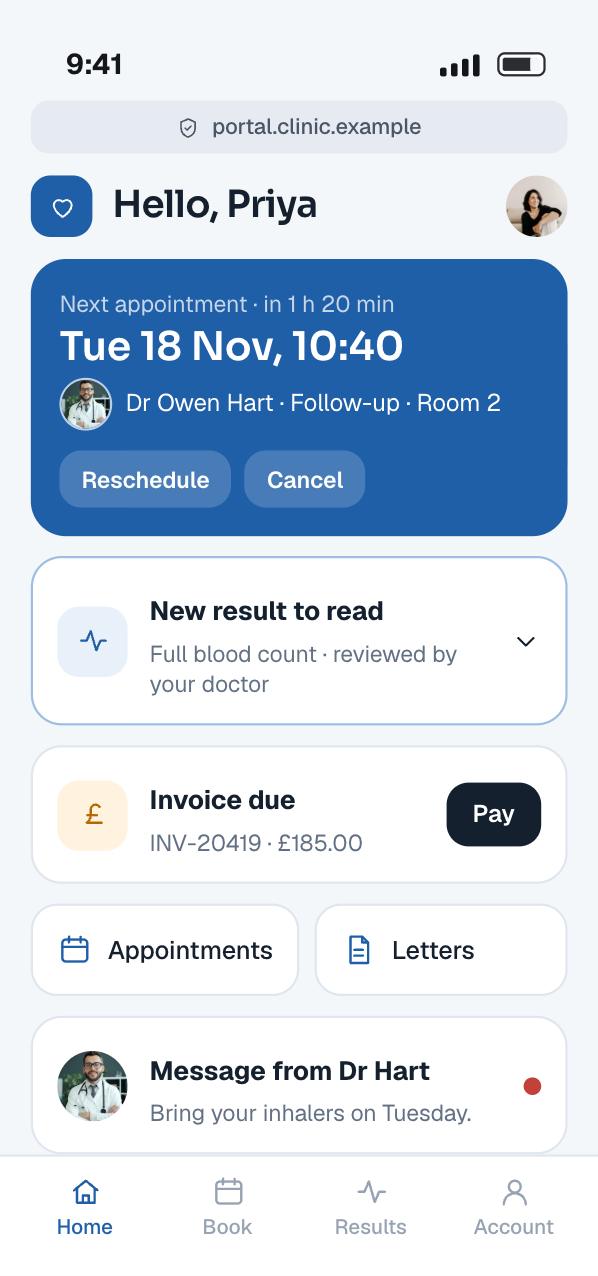
We have been building apps since 2019, and our longest client relationship is seven years and counting. A few examples from the many business systems we have built, where staff track people, bookings and payments in one place.
Healthcare
Clinic records platform
What we built
We built a clinic EMR platform for a healthcare business, covering patient management, electronic medical records and history, clinical notes, appointment scheduling, a doctor dashboard, a patient portal and billing. Laboratory integration uses HL7/FHIR data exchange, and it runs on React, Java, SQL and AWS.
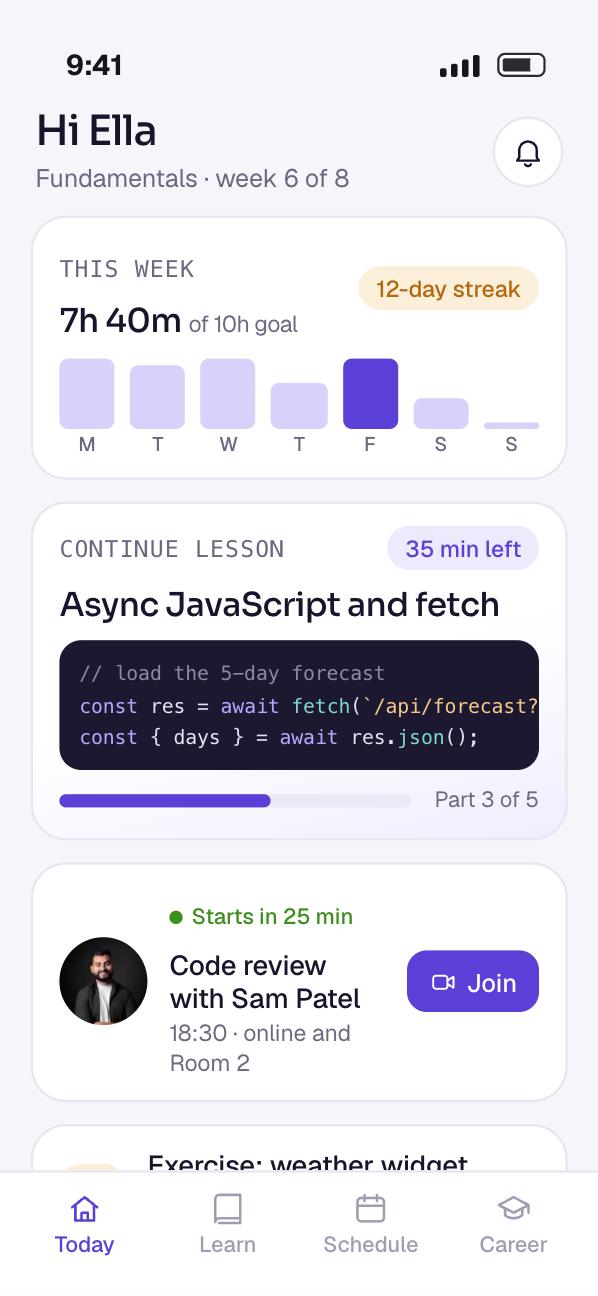
We built the admissions side of this coding school platform so each applicant is tracked automatically and staff no longer chase people by hand. Prospects book an information call online, and admissions, alumni and employer portals give each group its own view of the same records. Access is set by role, sign-in uses two factors, and it runs on Node.js, PostgreSQL and AWS.
“We needed one platform for the whole journey: comparing courses, booking a call, applying, then learning. AppAgentix built the website, the learning hub and the mobile app. Admissions now move 45% faster and information calls are up 38%. More than 5,000 learners use it, and 92% complete their course. They understood how a school actually runs, not just how to write the code.”
“We wanted one streaming service that felt the same on phone, tablet and TV, whether people watch free with adverts, subscribe or rent a film. AppAgentix built the apps for iPhone, iPad, Android and Apple TV and the service behind them. They got the hard parts right: playback that starts quickly, a home screen that works with a TV remote, and billing that stays correct. The Android app has passed 50,000 downloads.”
“Our patients needed the portal in their pocket: requesting visits, reading test results, reordering medicines and messaging their care team. AppAgentix built the Android app on our Epic MyChart system, careful where it matters: secure sign-in, no clinical detail on the lock screen, and patients choose what fitness data they share. The app has passed 50,000 downloads with 4.4 stars from over 750 reviews, and every release was tested before it reached our patients.”
The ten questions discovery starts with: users, the jobs they need done, systems to connect, rules, deadline and budget. Fill it in, attach nothing else, and the first call starts at the right place.
With us, a first version takes 8 to 14 weeks. A two-week discovery ends with one fixed figure for a signed scope, excluding VAT. Price your own version with the calculator on this page.
Start with one process, not the whole back office. Map how an order moves from quote to payment, build the module with the most retyping first, and link a standard package for payroll and statutory accounts.
Can I develop my own CRM?
Yes, if a developer stays to maintain it. A pipeline and contact list are quick; the data move, permissions, backups and UK data rules are slow and need an in-house owner.
What are the key differences between off-the-shelf software and custom software, and when should I choose which one?
Off-the-shelf software is rented per user and works the vendor’s way; custom costs more up front and follows your process. Choose custom when workarounds cost hours a week or the licence sum says so.
Why do so many CRM programs fail?
Mostly outside the code: a growing scope, unowned data and staff who never tried the system. Our controls: a signed scope, one named data owner and a week in a trial copy.
Do you really need a CRM in 2026?
Not always. A few people with a short customer list can use a shared spreadsheet, but once follow-ups get missed, start with a ready-made CRM.
Why do most ERP projects fail?
An ERP touches every team at once, so each risk is larger: too many modules going live together, and unchecked old data. We build one module at a time, with a signed check sheet before each launch.
How much do ERP systems cost?
A rented ERP is a licence bill, often priced per user each month, and Microsoft sends buyers to a partner for consulting services. With us, a CRM joined to custom ERP modules such as quotes, stock or jobs is priced module by module in the calculator on this page.
Let’s make your software project the one that ships on time.
More than 95% of our projects are delivered on or before the agreed date. About 60% of our clients come back for a second project.
What happens next
1We reply within 30 minutesEvery day of the year. A developer at our software development company, not a sales team, reads your brief.
2A 30-minute callWe ask about users, deadlines and the systems you already run.
3A written view in two working daysScope, timeline and a price range, yours to keep.
Thank you. Your brief is in.
A developer, not a sales team, reads it. We reply within 30 minutes, from info@appagentix.co.uk.
We use cookies to run this site and, with your permission, to understand how it is used. Cookie policy · Privacy policy
Let’s make your software project the one that ships on time.
More than 95% of our projects are delivered on or before the agreed date. About 60% of our clients come back for a second project.
What happens next
1We reply within 30 minutesEvery day of the year. A developer at our software development company, not a sales team, reads your brief.
2A 30-minute callWe ask about users, deadlines and the systems you already run.
3A written view in two working daysScope, timeline and a price range, yours to keep.
We wanted one streaming service that felt the same on phone, tablet and TV, whether people watch free with adverts, subscribe or rent a film. AppAgentix built the apps for iPhone, iPad, Android and Apple TV and the service behind them. They got the hard parts right: playback that starts quickly, a home screen that works with a TV remote, and billing that stays correct. The Android app has passed 50,000 downloads.
Michael S.CEO and Co-Founder, Play Now Media
Thank you. Your brief is in.
A developer, not a sales team, reads it. We reply within 30 minutes, from info@appagentix.co.uk.

 Ruth Okoye
 Sam Patel
 Leah Burrows
 Daniel Marsh
 Sophie Lennox
 Tom Hughes
 WCAG 2.2 AAAccessibility
 FigmaScreens and clickable prototypes you can test
 ReactThe library for web and native user interfaces
 Next.jsThe React framework for web applications
 TypeScriptTyped JavaScript that catches errors early
 Anthropic ClaudeClaude Fable 5.2, Opus 5.5, Sonnet 5.5, Haiku 5.5
 Google GeminiGemini 4 models for text, images, audio, video and PDF
 Node.jsJavaScript runtime for scalable network applications
 PythonLanguage for web development and scientific work
 PostgreSQLOpen-source database; pgvector adds vector search
 RedisIn-memory store for caching and live messages
 AWSCloud hosting with a London region
 Google CloudCloud hosting with a London region
 DockerPackages and runs an app in a container
 TerraformCloud set-up written as code, repeatable
 GitHub ActionsCI/CD platform to automate build, test and deployment
 SentryCaptures errors and alerts you with full context
 Web app developmentWeb platforms, portals and dashboards.
 Software modernisationRebuild ageing apps without losing users.
 Product engineeringWeb platforms, admin panels and APIs.
 Agentic AI developmentAI agents that complete tasks in your systems.
 Maintenance and supportUpdates, monitoring and OS releases.
 PricingWhat apps and AI agents cost, in pounds.
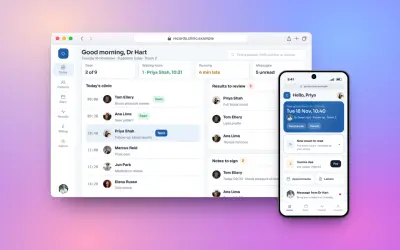 Clinic records systemPatient records, scheduling, billing and a patient portal.
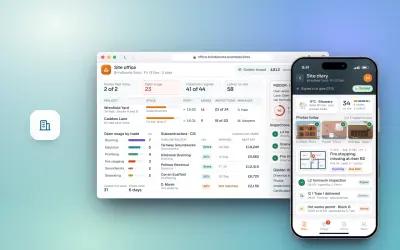 ConstructionSite, safety and project software.
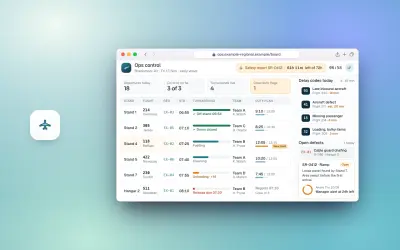 AviationMaintenance, crew and ground software.
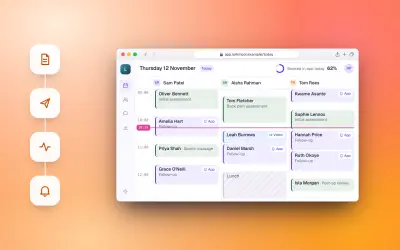 Healthcare softwareRecords, scheduling and clinical platforms.
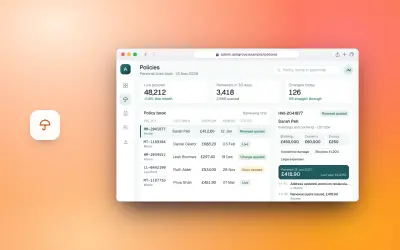 Insurance softwarePolicy, claims, underwriting and broker platforms.