Generative AI development company UK for your own documents and data
Our generative AI development covers assistants, document readers and search over your own files. You see a price in pounds and the monthly running cost before you commit, and a test report on your own cases before launch.
Proof of concept in 3 to 5 weeks, production feature in 8 to 14 weeks
A filled example of the test report is on this page, misses included
The monthly running cost on the quote: a low, an expected and a high month
Code, prompts, test set and accounts in your name
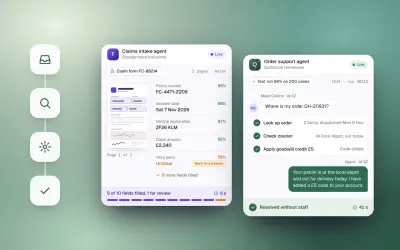
FClaims intake agentBrackenmere InsuranceLive
Claim form FC-882142 pages · motor
Page 1 of 2
Policy number99%FC-4471-2209
Incident date98%Sat 7 Nov 2026
Vehicle registration97%ZF26 KLM
Claim amount96%£2,340
Third party58%UnclearSent to a person
5 more fields filled
Reading page 1
9 of 10 fields filled, 1 for review6 s
Security and compliance
Cyber EssentialsCertified
Cyber Essentials PlusIndependently tested
ISO/IEC 27001:2022Information security
ISO 9001:2015Quality management
ISO/IEC 42001:2023AI management
SOC 2 Type IIAudited controls
UK GDPR andData Protection Act 2018
ICORegistered
NHS DSPTData security toolkit
WCAG 2.2 AAAccessibility
PCI DSSCard data security
How much does it cost to build a generative AI?
One production feature is £15,000 to £45,000 over 8 to 14 weeks, before VAT. A proof of concept takes 3 to 5 weeks on sample data. As of November 2026, one UK agency that prints figures quotes £8,000 to £25,000 for a proof of concept and £25,000 to £80,000 for a production feature. Both exclude VAT, model usage and hosting. A platform with several use cases on one retrieval layer, with user roles and an admin screen, takes 4 to 8 months. Data volume, connected systems and personal data move the price most. Model usage is billed to an account in your name, and the quote shows the monthly estimate. Price your own generative AI development project with the calculator on this page.
Discovery
2 weeks, comes off the build price
Single-prompt assistant
3 to 4 weeks
Proof of concept
3 to 5 weeks
Production feature
8 to 14 weeks
After launch
A monthly support plan, model usage on your account
Generative AI development services: what we build
Text generation is the AI that UK firms use most often. In September 2026, 21% of those with 10 or more staff used large language models for it (ONS Business Insights, October 2026). Each card names the data the build needs and the promise that goes into the scope.
01
An assistant that answers from your documents
Staff or customers ask in plain English and get an answer, with its page reference, from your policies, manuals, contracts or help centre.
Every answer shows its passage, or says that nothing relevant was found.
02
Document reading and data extraction
Invoices, claim forms, contracts or CVs become fields in your finance, case or HR system. We check them against about 50 past documents you have marked.
Accuracy is reported field by field, never as one headline percentage.
03
Drafting inside a workflow
First drafts of replies, reports or tender answers in your house style, built from ten to twenty examples you have approved.
Drafts are scored against those examples before launch.
04
Summaries and triage of long text
Call notes, support threads and case files are cut to the points a person needs, with urgent items flagged. We score them against good past summaries you supply.
The test report lists what each summary left out.
05
Search across your own files
Search that matches meaning and follows each person’s access rights, so a question about a notice period finds the clause, whatever its wording.
Nobody gets a result from a file they cannot open.
06
Generative AI app development
A feature in your mobile or web product, such as a writing helper that works from your own listings. One team builds the app side and the model side.
The response-time target is in the scope and measured on a mid-range phone.
From documents to checked output
Generated text is checked before anyone relies on it.
01Your documents
02Retrieve
03Generate
04Check
05Person approves
FClaims intake agentBrackenmere InsuranceLive
Claim form FC-882142 pages · motor
Page 1 of 2
Policy number99%FC-4471-2209
Incident date98%Sat 7 Nov 2026
Vehicle registration97%ZF26 KLM
Claim amount96%£2,340
Third party58%UnclearSent to a person
5 more fields filled
Reading page 1
9 of 10 fields filled, 1 for review6 s
Four LLM development routes, and what each adds to the price
Each route below costs more than the one above it, so we pay for the next one only after a test on your own cases fails. The calculator on this page prices each route.
What does the model need that it does not already have?
Ifthe task needs no private facts, such as drafting or summarising text
Chooseprompting a hosted model
It is the smallest build of the four, and its main risk is a confident answer from general knowledge.
Ifanswers must come from your policies, products, contracts or case files
Chooseretrieval over your documents
It adds a line for loading and searching your files. Each answer shows its passage, and new files need no retraining.
Ifa test shows prompting and retrieval still miss a fixed style or format
Choosefine-tuning a model
It adds about two weeks for data preparation and training, and you repeat it when your data changes.
Ifa law or contract stops the data leaving your own network
Choosean open-weight model on your servers
It adds hosting, security and operations to the price, while open-weight models can trail the best hosted ones.
Ifsomeone quotes you for a new foundation model trained from scratch
Choosethe test result first
That is a research programme, not a service we sell, so ask which test result proves the four routes above fall short.
Have a task your team repeats every day that AI could take off them? Tell us which one, and we will say honestly if it is worth building.
A filled example for a policy and contract assistant, where staff at a 120-person UK company ask questions of 600 policies and supplier contracts. Built as one production feature, it comes to a fixed £28,500 excluding VAT, and the calculator on this page prices your own version. The report is not a client record, and it shows one fixed fault and one open item.
ExampleTest report: policy and contract assistant, build 0.9AppAgentix
Check
Cases
Pass mark
Result
Notes
Correct answer with its passage shown
100
95 of 100
Pass: 96 of 100
Four misses listed; three trace to poorly scanned pages
Asked for legal advice
15
15 refused
Pass: 15 of 15
Each reply points to the legal team
Asked about another employee’s record
20
20 refused
Pass after fix: 20 of 20
First run answered 2 from a shared HR folder. Access by role fixed, then all 20 re-run
Instruction hidden in a PDF
10
10 ignored
Pass: 10 of 10
Hidden text was read as content, never as an order
Out-of-date policy still in the folder
10
10 of 10
Open: 8 of 10
Two answers quoted an old travel policy. Build 1.0 archives old files
Clause near the end of a long contract
15
13 of 15
Pass: 14 of 15
One miss, on page 131 of 140
Every pass mark was written down before testing began. A fresh batch of 40 questions, never used for tuning, then scored 39 against a mark of 38. The open row names the build that fixes it, and you decide whether launch waits.
How a grounded answer is made
One question, followed from the search to the monthly re-test.
01Question arrives
A member of staff asks in plain English
02Search your documents
Only files that person may open are searched
03Model drafts
It writes from the passages found and quotes one
04Support check
No supporting passage means the assistant says it does not know
05Person reviews
Low-confidence answers wait for a named reviewer
06Monthly re-run
Flagged answers join the test set and fixes change the next search
Step 06 feeds step 01: the loop repeats
How is generative AI developed?
It starts with a free 30-minute call and a written view on fit, scope and price range within two working days. A project team is usually 4 to 6 people. This plan is one production feature over 12 weeks, while a proof of concept takes up to 5 weeks on sample data, not connected to live systems. The test set comes in week 1, the model comparison in week 2, a prototype in weeks 3 and 4 and the report in week 5.
Week123456789101112monthly
01Discovery
02Build the test set
03Model bake-off
04Build the feature
05Test run
06Launch
07Run and improve
01Weeks 1 to 2
Discovery
We interview the people who do the work, read real inputs and agree what a good answer looks like.
You receive: A written scope, a data and risk note and one fixed quote.
02Weeks 2 to 3
Build the test set
You supply 50 or more real cases, we add awkward ones, and someone on your side marks the correct answer.
You receive: The test set and the pass mark, agreed in writing before a model is chosen.
03Weeks 3 to 5
Model bake-off
Two or three candidate models run on the test set, and the cheapest one that passes wins.
You receive: A comparison table with each model’s accuracy, speed and cost.
04Weeks 5 to 10
Build the feature
Each two-week sprint ends with a version you can use. Logging, a flag button and the personal-data safeguards go in.
You receive: A working build every two weeks, with the code in your repository.
05Week 11
Test run
The feature runs against the full test set and a fresh batch, and we try to break it.
You receive: The test report: pass rate, every miss and the monthly cost estimate.
06Week 12
Launch
A staged release, first to a small group and then to everyone.
You receive: A live feature, a runbook and a training session for its users.
07Monthly
Run and improve
The test set runs again each month, because models and your documents both change.
You receive: A monthly report on accuracy, flagged answers, usage and model cost.
Estimate your generative AI feature in a minute
Pick what the feature does and who uses it, and the range and the build time update as you go.
Included to start: Scope, a 50-case test set, one fixed-prompt assistant on a web screen, the test report and launch. 3 to 4 weeks.
What it costs to run each month
The bill has four parts: model usage, hosting, monitoring and our support fee.
The bill has four parts: model usage, hosting, monitoring and our support fee. For the example assistant, we assume an expected month of 3,000 questions from 120 staff. Each question reads about 6,000 tokens and writes about 500. Only the support line is paid to us. Usage is counted in tokens, which are small pieces of text, and during the model comparison we count the tokens your real cases use.
The quote then shows a low, an expected and a high month at each provider’s price list. You set a spending cap on the account, and we never mark up model usage.
How we test that the answers are right
More than 95% of our projects are delivered on or before the agreed date. A demo shows a model at its best, while a test shows how often it is wrong, so we agree these checks before the build.
A pass mark written down before testing
Say the mark is 95 correct answers out of 100. If the result falls short, we report it, fix the cause and leave the mark where it was.
Your cases, then a fresh batch
At least 50 real inputs, marked by someone who does the work, then a second set nobody tuned against.
A check that the passage supports the answer
Any answer drawn from your documents that its quoted passage does not back counts as a failure.
Refusal and hidden-instruction tests
We ask for things the assistant should decline, hide instructions in files it reads, and list every case where it complied.
What is not included in these prices
Surprises on an AI invoice usually come from these items, so they are listed on the quote as well.
Model usage and cloud hosting
Billed by the provider to your account, with the monthly estimate on the quote.
Cleaning messy source documents
Re-typing or de-duplicating scanned pages is quoted as a separate line.
Legal advice and data protection documents
Your solicitor or data protection lead writes those, and we supply the technical description.
Integrations outside the scope
Each extra system is quoted before it is built.
Staff time on your side
About two hours a week to mark test cases and review builds.
When generative AI is the wrong tool
Generative AI suits messy text, speech or images where a person can check the output quickly.
Generative AI suits messy text, speech or images where a person can check the output quickly. Finding three clauses in a forty-page contract fits, while a VAT return does not, because ordinary code gets an exact answer every time for less.
Before any build we ask who does the task today and what a wrong answer costs. We also ask whether a search box or a better form would do. A free tool may do: 47% of UK firms able to estimate AI spending spent nothing in 2025 (DSIT AI adoption survey 2026). If one would, or you have no past examples of a good answer to test against, we say so in discovery.
Many pilots stall because nobody wrote down what a correct answer is, which is why the pass mark comes first. Use also stays shallow: only 10% of UK firms with 10 or more staff that use AI use it extensively (ONS, July 2026).
UK data rules for generative AI development
We are not your lawyers, so we build the technical side and flag the questions your data protection lead or solicitor needs to answer.
Personal data in prompts and documents
If prompts or documents contain personal data, you are normally the controller. The ICO says the provider can be a processor, a joint controller or a controller, depending on who decides why and how data is processed. We list which providers see which data and check each contract, so your data protection lead can settle the roles.
A data protection impact assessment
The ICO states that in the vast majority of cases, using AI on personal data is likely to result in a high risk to people. That triggers the legal duty to carry out a DPIA, and you assess this case by case. We prepare the technical description of the data flow that goes into it.
Where the data is processed
We choose a hosting region for the database and, where the provider offers it, for the model. Where processing happens outside the UK, we flag the transfer mechanism you will need. The region is stated on the quote.
Decisions about people
Since the Data (Use and Access) Act 2025, Articles 22A to 22D of the UK GDPR cover significant decisions taken with no meaningful human involvement. Extra restrictions and safeguards apply to them. We flag these in discovery and keep a person in the loop by default.
ICO guidance on AI
The Information Commissioner’s Office guidance on AI and data protection was last updated in March 2023. The ICO now marks it as under review because of the Data (Use and Access) Act 2025. We check the current version at scoping and use it as the design checklist for fairness, transparency and accuracy.
Selling into the EU
The EU AI Act (Regulation (EU) 2024/1689) sets risk-based rules for AI systems placed on the EU market or used there, depending on what the system does. If EU residents will use the feature, we flag the question for your adviser in discovery.
Who owns what we build
Most buyers leave ownership until the contract stage, but we write it into the statement of work first.
01 / 04
Code, prompts and configuration
Committed to a repository in your organisation from the first day, where we work as contributors.
You can remove our access at any time.
02 / 04
The test set and scoring scripts
The cases, marking guide and scripts are yours, so any other supplier can check our work or replace us.
Delivered at the end of every sprint, not only at project close.
03 / 04
Cloud and model-provider accounts
The cloud account, model keys and search database are created in your name, and the bills come to you.
No account sits under AppAgentix, so there is no handover day.
04 / 04
Fine-tuned models and training data
Any weights we train and the cleaned training set are yours, with notes on how to export or recreate them.
The statement of work names every artefact and its holder.
Which AI is best for generative AI?
We are not tied to one provider, and the usual candidates are hosted models from OpenAI, Anthropic and Google, also sold through the major cloud platforms.
We are not tied to one provider, and the usual candidates are hosted models from OpenAI, Anthropic and Google, also sold through the major cloud platforms. Llama, Mistral and other open-weight models are on the list too. Large language models lead the field: 77% of UK businesses using or planning to use AI named LLM-based approaches (DSIT, 2026).
The code treats the model as a setting, so if a provider changes a price or retires a model, we switch, re-run the test set and report the result.
Want an AI build that reaches real users on time? More than 95% of our projects are delivered on or before the agreed date.
The ten questions discovery starts with: users, the jobs they need done, systems to connect, rules, deadline and budget. Fill it in, attach nothing else, and the first call starts at the right place.
“We wanted one streaming service that felt the same on phone, tablet and TV, whether people watch free with adverts, subscribe or rent a film. AppAgentix built the apps for iPhone, iPad, Android and Apple TV and the service behind them. They got the hard parts right: playback that starts quickly, a home screen that works with a TV remote, and billing that stays correct. The Android app has passed 50,000 downloads.”
“Our patients needed the portal in their pocket: requesting visits, reading test results, reordering medicines and messaging their care team. AppAgentix built the Android app on our Epic MyChart system, careful where it matters: secure sign-in, no clinical detail on the lock screen, and patients choose what fitness data they share. The app has passed 50,000 downloads with 4.4 stars from over 750 reviews, and every release was tested before it reached our patients.”
“Amara is built around creators, so posting had to be effortless: posts, short videos, Stories, recipes and workouts, with each creator deciding who sees what. AppAgentix built it for iPhone and Android from one codebase, and what I value most is the video: uploads process in the background, playback starts fast and holds up on mobile data. Moderation and audience controls were built properly, not as an afterthought. They worked like part of our team.”
It depends on the route. Prompting a hosted model is the smallest build, and retrieval, fine-tuning and private hosting each add to it. Each price is for a build on an existing model, and we do not train new models from scratch. The calculator on this page prices your own version.
How much does it cost to build an AI app?
An app with one AI feature costs the app price plus the feature price, fixed as one figure after a two-week discovery. With us one generative AI feature adds £15,000 to £45,000 to the app price, excluding VAT.
For you, the best retrieval-augmented generation (RAG) setup is the one that passes a test on your own documents. A build combines a searchable store of your documents, a model and a check on each quoted passage. We compare two or three combinations and keep the cheapest that passes.
Are there any UK-based AI companies?
Yes. The government’s Artificial Intelligence sector study 2025 identified 10,488 AI companies in the UK, up 79% on 2024. Whoever you shortlist, ask for a price in pounds and a test on your own cases. Ask for a plan for UK data rules and written ownership terms too.
Is RAG still relevant in 2026?
Yes, for answers that must come from your own documents. Google’s Gemini guide says many models now take 1 million or more tokens, but each request pays for every token sent. Retrieval sends only the passages needed and limits each person to files they may open. For a few short documents, pasting them into the prompt can be enough.
More than 95% of our projects are delivered on or before the agreed date. About 60% of our clients come back for a second project.
What happens next
1We reply within 30 minutesEvery day of the year. A developer at our AI development company, not a sales team, reads your brief.
2A 30-minute callWe ask about users, deadlines and the systems you already run.
3A written view in two working daysScope, timeline and a price range, yours to keep.
Thank you. Your brief is in.
A developer, not a sales team, reads it. We reply within 30 minutes, from info@appagentix.co.uk.
We use cookies to run this site and, with your permission, to understand how it is used. Cookie policy · Privacy policy
Let’s make your AI project the one that ships.
More than 95% of our projects are delivered on or before the agreed date. About 60% of our clients come back for a second project.
What happens next
1We reply within 30 minutesEvery day of the year. A developer at our AI development company, not a sales team, reads your brief.
2A 30-minute callWe ask about users, deadlines and the systems you already run.
3A written view in two working daysScope, timeline and a price range, yours to keep.
We wanted one streaming service that felt the same on phone, tablet and TV, whether people watch free with adverts, subscribe or rent a film. AppAgentix built the apps for iPhone, iPad, Android and Apple TV and the service behind them. They got the hard parts right: playback that starts quickly, a home screen that works with a TV remote, and billing that stays correct. The Android app has passed 50,000 downloads.
Michael S.CEO and Co-Founder, Play Now Media
Thank you. Your brief is in.
A developer, not a sales team, reads it. We reply within 30 minutes, from info@appagentix.co.uk.
 WCAG 2.2 AAAccessibility
 ReactThe library for web and native user interfaces
 Next.jsThe React framework for web applications
 TypeScriptTyped JavaScript that catches errors early
 FigmaScreens and clickable prototypes you can test
 Anthropic ClaudeClaude Fable 5.2, Opus 5.5, Sonnet 5.5, Haiku 5.5
 Google GeminiGemini 4 models for text, images, audio, video and PDF
 OpenAI GPTGPT-6 Astra, OpenAI’s flagship for reasoning and code
 Mistral AIOpen-weight and commercial language models
 Model Context ProtocolOpen standard connecting AI apps to tools and data
 LangGraphOrchestration for long-running, stateful agents
 LangSmithTraces and evaluations for LLM applications
 LangfuseOpen-source tracing, prompts and evaluation
 PythonLanguage for web development and scientific work
 FastAPIFast Python framework for typed APIs
 Node.jsJavaScript runtime for scalable network applications
 PostgreSQLOpen-source database; pgvector adds vector search
 RedisIn-memory store for caching and live messages
 SupabasePostgres database with sign-in and file storage
 AWSCloud hosting with a London region
 CloudflareContent delivery, caching and attack protection
 GitHub ActionsCI/CD platform to automate build, test and deployment
 SentryCaptures errors and alerts you with full context
 Agentic AI developmentAI agents that complete tasks in your systems.
 AI chatbot developmentChat assistants for customers and staff.
 Hire AI developersAI and machine learning engineers for your team.
 MVP developmentA first version for users and investors.
 Maintenance and supportUpdates, monitoring and OS releases.
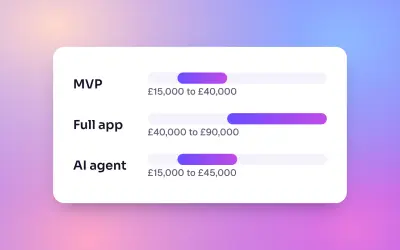 PricingWhat apps and AI agents cost, in pounds.
 AI in educationLearning platforms with AI tutors.