AI education system development for UK schools, colleges and universities: tutors, practice and feedback
Our AI education system development covers AI tutors on your own materials, adaptive practice and teacher-approved feedback. Each is designed around England's DfE safety standards and the ICO Children's code.
Hints before answers, alerts to your safeguarding lead
Code, prompts and accounts in your name
9:41
Thursday · 25 min left todayHi Maya12 days
GCSE Combined ScienceUnit 4 · Bioenergetics7 of 11 lessons · test Fri 27 Nov
Lesson 7 · 5:12 of 12:00
Respiration in muscles18 min · quiz 9/10
7Rate of photosynthesis12 min · in progress
8Required practical: pondweed20 min
Why does the rate stop going up?
Look at the graph after 30 units of light. Which other factor could be limiting it now?
Rules this build is planned around
DfE generative AI product safety standardsEdtech suppliers to schools and colleges in England
ICO Children's codeEdtech children use directly, or via a school where the provider shapes purposes
UK GDPR and the DPIAAnyone processing learners' personal data
Filtering and monitoring standardsSchools and colleges in England, under Keeping children safe in education
Security and compliance
Cyber EssentialsCertified
Cyber Essentials PlusIndependently tested
ISO/IEC 27001:2022Information security
ISO 9001:2015Quality management
ISO/IEC 42001:2023AI management
SOC 2 Type IIAudited controls
UK GDPR andData Protection Act 2018
ICORegistered
NHS DSPTData security toolkit
WCAG 2.2 AAAccessibility
PCI DSSCard data security
What does AI education system development involve for a UK school or university?
It means education software in which an AI tutor, practice engine or feedback aid works from your own course materials. In England, the DfE product safety standards shape its behaviour: hints before answers, logged chats and alerts to your safeguarding lead. A first version takes 8 to 14 weeks, and a fixed quote follows a two-week discovery.
Discovery
2 weeks, fixed quote
MVP
8 to 14 weeks
Full system
4 to 8 months
Support
Monthly fixes and monitoring
What do we build in an AI education system?
01
AI tutor on your own course materials
Learner
It answers only from the notes you load, hint first, and teachers set topics, session length and when a full solution shows.
02
Adaptive practice
Learner
It picks the next question from the learner's mistakes, inside your scheme of work, and syncs scores to your learning platform, and reading level follows SEND needs.
03
Feedback and marking aid
Teacher
It drafts feedback against your mark scheme, and a teacher approves it before a learner sees it, while learner work never trains a model.
04
Admissions and enquiry help
Admissions team
It answers course questions from your prospectus, says it is automated and logs enquiries in your CRM.
05
Progress and safeguarding view
Teachers and DSL
Session time, offloading flags and alerts per class, where high-risk alerts go to the DSL contact confirmed at setup.
06
The learning hub around the AI
Whole school
Course area, cohort schedule, progress dashboards and role-based access, as in our coding school platform, linked to your MIS.
Building in ai education system development means rules you cannot get wrong. Talk them through with the developers who would build to them.
We are an engineering team, not a law firm, so your data protection officer and safeguarding lead confirm the legal position, with rules as of November 2026.
DfE generative AI product safety standards
Applies to
Edtech suppliers to schools and colleges in England
What it changes in the build
This DfE guidance for suppliers was updated on 19 January 2026. It added standards on cognitive, emotional and social development, mental health and manipulation.
ICO Children's code
Applies to
Edtech children use directly, or via a school where the provider shapes purposes
What it changes in the build
Not when acting solely on school instructions. In our builds the school decides the purposes, and data protection law applies either way.
UK GDPR and the DPIA
Applies to
Anyone processing learners' personal data
What it changes in the build
The DfE standards expect a DPIA during development and for the tool's life. We deliver the data map your data protection officer signs off.
Filtering and monitoring standards
Applies to
Schools and colleges in England, under Keeping children safe in education
What it changes in the build
The DSL leads on safeguarding, so our alerts feed the DSL's reports and never replace the school's own filtering.
Public sector accessibility regulations
Applies to
Public sector sites and apps; schools and nurseries partly exempt, student-only mobile apps not covered
What it changes in the build
Your legal adviser confirms if they cover your university or college, and we build to WCAG 2.2 AA either way.
How do the DfE safety standards change the tutor's screens?
DfE standardWhat the tutor does
01DfE standardFiltering
What the tutor doesBlocks harmful content, set by age and SEND need
02DfE standardMonitoring and reporting
What the tutor doesLogs every reply and alerts the DSL
03DfE standardCognitive development
What the tutor doesHints first, full solution after a real attempt
04DfE standardCognitive offloading
What the tutor doesFlags pasted answers for the teacher
05DfE standardEmotional and social development
What the tutor doesNo "I think", no name or avatar
06DfE standardTime limits
What the tutor doesBreak prompts, then a hard stop a teacher can lift with a reason
07DfE standardMental health
What the tutor doesSignposts help and flags the DSL, never secrecy
08DfE standardManipulation
What the tutor doesNo flattery, low-stakes badges only
09DfE standardPrivacy and intellectual property
What the tutor doesNo learner data used to train models
“We needed one platform for the whole journey: comparing courses, booking a call, applying, then learning. AppAgentix built the website, the learning hub and the mobile app. Admissions now move 45% faster and information calls are up 38%. More than 5,000 learners use it, and 92% complete their course. They understood how a school actually runs, not just how to write the code.”
“We wanted one streaming service that felt the same on phone, tablet and TV, whether people watch free with adverts, subscribe or rent a film. AppAgentix built the apps for iPhone, iPad, Android and Apple TV and the service behind them. They got the hard parts right: playback that starts quickly, a home screen that works with a TV remote, and billing that stays correct. The Android app has passed 50,000 downloads.”
“Our patients needed the portal in their pocket: requesting visits, reading test results, reordering medicines and messaging their care team. AppAgentix built the Android app on our Epic MyChart system, careful where it matters: secure sign-in, no clinical detail on the lock screen, and patients choose what fitness data they share. The app has passed 50,000 downloads with 4.4 stars from over 750 reviews, and every release was tested before it reached our patients.”
A few examples from the many apps we have built where people learn, or watch live and recorded video, and pick up where they left off.
Education, web and React Native
Coding school platform
What we built
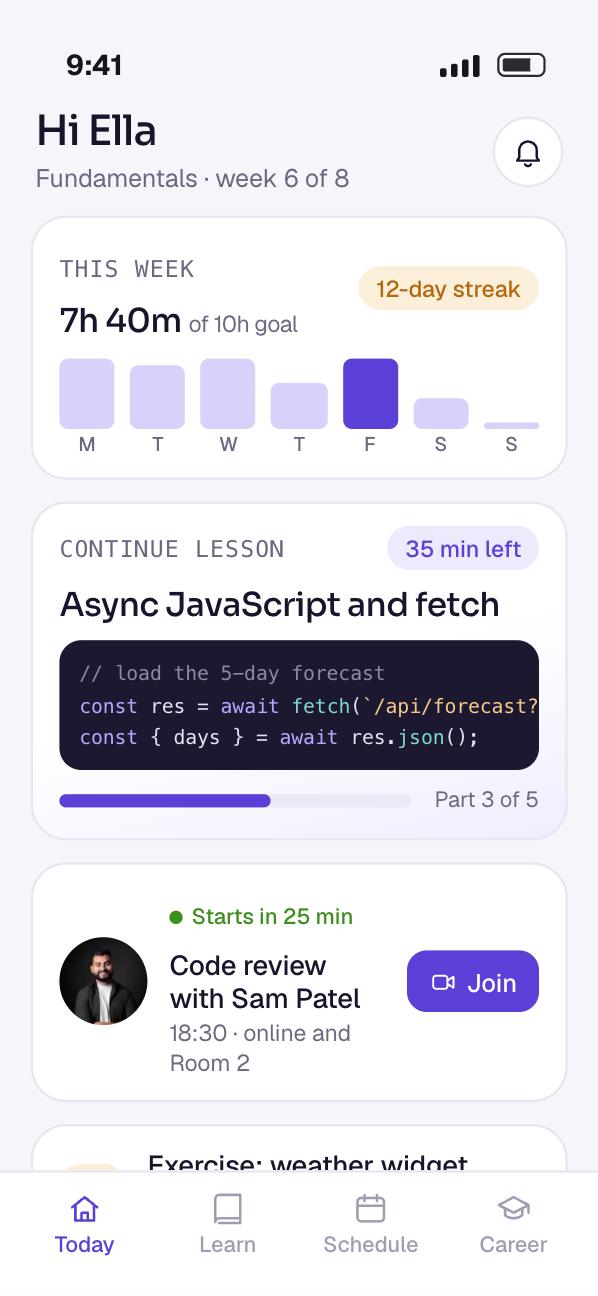
A coding school wanted one journey from course choice to first job. We built a web platform and a React Native app with course pages, call booking, admissions, a learning hub and employer portals.
5,000+active learners, 38% more information calls booked, 45% faster from application to enrolment, 92% course completion, 60+ hiring partners
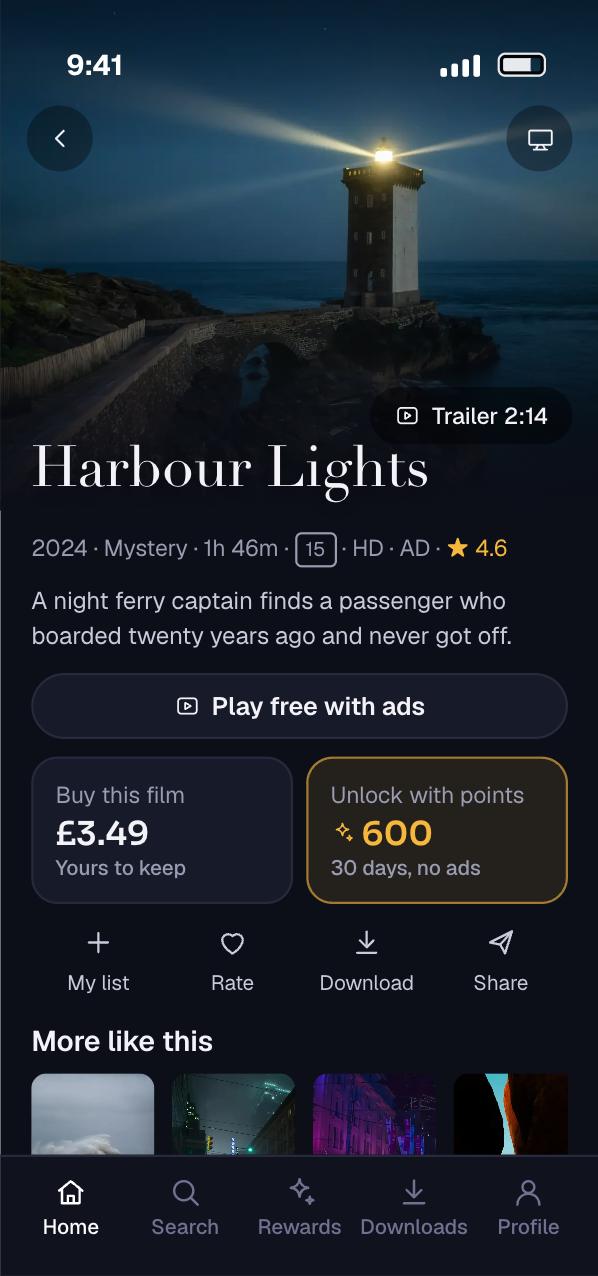
In this streaming service app, which our team built, live channels and titles watched on demand share one player. Each viewer has a profile with a watchlist and resumes from the point they stopped, and age-based restrictions keep younger viewers to suitable titles. It runs on Node.js and MongoDB on AWS, with HLS video through a CDN.
How much does AI education system development cost?
What each stage includes and how long it takes. One worked example, a trust revision tutor on its GCSE science notes, came to £35,500 excluding VAT. Price your own version with the calculator below.
01
Discovery
2 weeks
Scope, data map, fixed quote; off the build price.
02
MVP
8 to 14 weeks
Learning web app, one AI feature.
03
Full system
4 to 8 months
Learner, teacher and leader apps, MIS link, safeguarding layer, WCAG 2.2 AA.
04
AI feature, one workflow
quoted per feature
Added to a platform you run.
05
Support
monthly
Fixes and monitoring; 30 days' notice after 3 months.
Three months of fixes included. Model usage is on the quote. Every rate is on our app development cost page.
Estimate your AI learning system in a minute
Pick what you need first.
Included to start: Discovery, design, learner and teacher web app, launch. 6 to 8 weeks.
What do you own, and what do we refuse to build?
What you own, what we refuse, and one promise.
Code, designs and prompts
In your repository from the first commit.
AI and cloud accounts
In your name; remove us any time.
Data region
UK or EU, written on the quote.
Handover pack
Runbook, diagram and recorded walkthrough.
No per-learner fee
Model usage is on the quote.
No grading without a teacher
A teacher signs off every grade.
No AI cheating detection
We do not build it.
No training on children's work
Chat logs stay for safeguarding only, and no learner work is reused.
No friendly persona
No chatbot that says "I" or poses as a friend.
Refund promise
If we do not deliver what the written scope promises, we refund what you paid for the undelivered work within 7 days.
Three ways to work with us
Pick by how much you can write down today. Prices in pounds, excluding VAT.
Fixed-price build
Best whenYou can say what the product must do, and want one figure before work starts.
Price
AI agent for one workflow from £15,000, running cost on the quote
Two weeks of discovery first, its fee taken off the build price
Website question bot in 3 to 5 weeks
Terms
One fixed figure in writing after discovery
Fixes for 90 days after launch included
If we do not deliver what the written scope promises, we refund what you paid for the undelivered work within 7 days.
You own the code, designs and accounts from the first commit.
The ten questions discovery starts with: users, the jobs they need done, systems to connect, rules, deadline and budget. Fill it in, attach nothing else, and the first call starts at the right place.
Built by us, an AI tutor on your own course materials costs £15,000 to £25,000 as a feature, excluding VAT. A whole first version carries no per-learner licence fee, and model usage is shown on the quote. Our team uses AI tools to work faster.
What is adaptive learning?
Adaptive learning, as we build it, is practice that picks each learner's next question from their mistakes. It works inside your own scheme of work. Scores sync to your learning platform, and the reading level follows each learner's SEND needs.
What are some examples of adaptive learning methods?
The methods we build pick the next question from a learner’s mistakes, and hints grow in detail step by step. Reading level follows each learner’s SEND needs. Adaptive practice needs no open chat, so there is less to safeguard.
How do you create an AI tutor?
You create an AI tutor by connecting five parts in order, each tested on real questions. A learner asks inside a course unit, filters check every message, and answers come only from your notes. A hint ladder gives a hint, then a partial step, and the full answer only after a real attempt. Every reply is logged, so teachers see pasted answers and your safeguarding lead gets high-risk alerts.
Is AI tutor worth it?
An AI tutor is worth it when learners need help between lessons and your course notes are already in order. It is worth it only when a teacher reviews its misses first, which our tutor test run builds in before launch. Where a product you can buy already does the job, we advise buying, since a licence usually costs less than a build.
How is AI being used in education?
In the education systems we build, AI is used for tutoring, adaptive practice, feedback drafting and answering admissions enquiries. An AI tutor answers from your own course notes, hint first, and adaptive practice picks the next question from each learner's mistakes. A feedback aid drafts comments against your mark scheme, and a teacher approves them before any learner sees them.
More than 95% of our projects are delivered on or before the agreed date. About 60% of our clients come back for a second project.
What happens next
1We reply within 30 minutesEvery day of the year. A developer at our AI development company, not a sales team, reads your brief.
2A 30-minute callWe ask about users, deadlines and the systems you already run.
3A written view in two working daysScope, timeline and a price range, yours to keep.
Thank you. Your brief is in.
A developer, not a sales team, reads it. We reply within 30 minutes, from info@appagentix.co.uk.
We use cookies to run this site and, with your permission, to understand how it is used. Cookie policy · Privacy policy
Let’s make your AI project the one that ships.
More than 95% of our projects are delivered on or before the agreed date. About 60% of our clients come back for a second project.
What happens next
1We reply within 30 minutesEvery day of the year. A developer at our AI development company, not a sales team, reads your brief.
2A 30-minute callWe ask about users, deadlines and the systems you already run.
3A written view in two working daysScope, timeline and a price range, yours to keep.
We wanted one streaming service that felt the same on phone, tablet and TV, whether people watch free with adverts, subscribe or rent a film. AppAgentix built the apps for iPhone, iPad, Android and Apple TV and the service behind them. They got the hard parts right: playback that starts quickly, a home screen that works with a TV remote, and billing that stays correct. The Android app has passed 50,000 downloads.
Michael S.CEO and Co-Founder, Play Now Media
Thank you. Your brief is in.
A developer, not a sales team, reads it. We reply within 30 minutes, from info@appagentix.co.uk.

 WCAG 2.2 AAAccessibility
 ReactThe library for web and native user interfaces
 Next.jsThe React framework for web applications
 TypeScriptTyped JavaScript that catches errors early
 FigmaScreens and clickable prototypes you can test
 Anthropic ClaudeClaude Fable 5.2, Opus 5.5, Sonnet 5.5, Haiku 5.5
 Google GeminiGemini 4 models for text, images, audio, video and PDF
 OpenAI GPTGPT-6 Astra, OpenAI’s flagship for reasoning and code
 Mistral AIOpen-weight and commercial language models
 Model Context ProtocolOpen standard connecting AI apps to tools and data
 LangGraphOrchestration for long-running, stateful agents
 LangSmithTraces and evaluations for LLM applications
 LangfuseOpen-source tracing, prompts and evaluation
 PythonLanguage for web development and scientific work
 FastAPIFast Python framework for typed APIs
 Node.jsJavaScript runtime for scalable network applications
 PostgreSQLOpen-source database; pgvector adds vector search
 RedisIn-memory store for caching and live messages
 SupabasePostgres database with sign-in and file storage
 AWSCloud hosting with a London region
 CloudflareContent delivery, caching and attack protection
 GitHub ActionsCI/CD platform to automate build, test and deployment
 SentryCaptures errors and alerts you with full context
 Generative AI developmentAI features that write, summarise and search.
 AI chatbot developmentChat assistants for customers and staff.
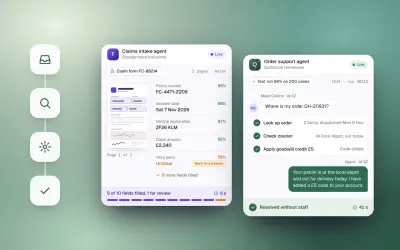 Agentic AI developmentAI agents that complete tasks in your systems.
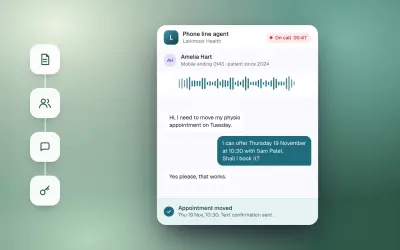 Hire AI developersAI and machine learning engineers for your team.
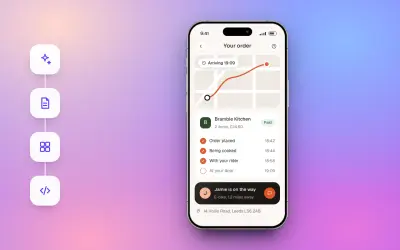 MVP developmentA first version for users and investors.
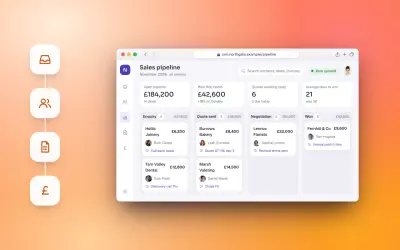 Custom CRM and ERPBusiness systems shaped around how you work.
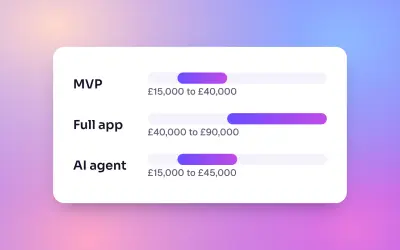 PricingWhat apps and AI agents cost, in pounds.
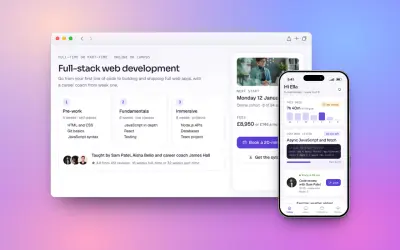 Coding school platformAdmissions, a learning hub, cohorts and employer portals.