Legacy software modernisation for UK businesses, one working stage at a time
For legacy software modernisation, we take over ageing business software, make it safe, then replace it in slices while your staff keep working. The code and hosting sit in your name.
Old and new systems run side by side until you approve the switch
app.larkmoor.example/today
Thursday 12 NovemberTodayBooked in app today61 2%HP
SPSam PatelARAisha RahmanTRTom Rees
09:0010:0011:0012:00
Oliver BennettInitial assessment
Amelia HartFollow-upApp
Priya ShahSports massage
Grace O'NeillFollow-upApp
Tom FletcherBack pain assessment
Leah BurrowsVideo
Daniel MarshFollow-upApp
Lunch
Kwame AsanteApp
Sophie LennoxInitial assessment
Hannah PriceFollow-upApp
Ruth OkoyeFollow-upApp
Isla MorganPost-op review
10:24
New booking from the appHannah Price, 10:30 with Tom Rees
Security and compliance
Cyber EssentialsCertified
Cyber Essentials PlusIndependently tested
ISO/IEC 27001:2022Information security
ISO 9001:2015Quality management
ISO/IEC 42001:2023AI management
SOC 2 Type IIAudited controls
UK GDPR andData Protection Act 2018
ICORegistered
NHS DSPTData security toolkit
WCAG 2.2 AAAccessibility
PCI DSSCard data security
What does legacy software modernisation cost, and how long does it take?
A first modernisation stage with AppAgentix costs £15,000 to £40,000 excluding VAT and takes 8 to 14 weeks. A larger system, done in several stages, takes 4 to 8 months. A two-week assessment comes first and ends in a fixed quote. After switchover, a monthly support plan starts and hosting is billed to your own account. For a small clinic’s five-module system, three years of modernising come to £68,150, less than keeping the old one running. Price your own version with the calculator on this page.
We make one small change on a copy and time it from request to release.
The time one change takes, beside the cost of each route.
02
Support dates
We list each server, database and library with its vendor’s end-of-support date. Microsoft’s last paid updates for Windows Server 2012 R2 ended in October 2026, while Windows 10 still had 13.8% of UK Windows desktop browsing in October 2026 (StatCounter, October 2026).
Each date beside the route it points to.
03
Hand-copied figures
We count the figures two or three daily users copy between systems in a normal day.
Each connection priced as its own quote line.
04
The cost of keeping it
We add up servers, licences and contractor fixes from your last twelve months of invoices.
The three-year cost of keeping it, beside each route.
Old system to new, without a big switch-off
The old system keeps running while each part moves across in turn.
01Audit
02Wrap with an API
03Move one part
04Run side by side
05Retire the old part
app.larkmoor.example/today
Thursday 12 NovemberTodayBooked in app today61 2%HP
SPSam PatelARAisha RahmanTRTom Rees
09:0010:0011:0012:00
Oliver BennettInitial assessment
Amelia HartFollow-upApp
Priya ShahSports massage
Grace O'NeillFollow-upApp
Tom FletcherBack pain assessment
Leah BurrowsVideo
Daniel MarshFollow-upApp
Lunch
Kwame AsanteApp
Sophie LennoxInitial assessment
Hannah PriceFollow-upApp
Ruth OkoyeFollow-upApp
Isla MorganPost-op review
10:24
New booking from the appHannah Price, 10:30 with Tom Rees
Legacy system replacement or modernisation: wrap, slice or rebuild?
Route names follow the common R words.
Which route?
IfThe software works and the risk is one person or missing backups
ChooseRetain and stabilise
The code stays; we add backups, tests and documents, then a monthly support plan.
IfThe server, database or runtime is out of support
ChooseRehost or replatform
Rehosting moves it unchanged; replatforming also swaps the database or runtime. Priced as a first stage.
IfUsers or partners need a new front on a sound core
ChooseWrap with an API
A modern interface sits in front while the old core keeps calculating.
IfYou cannot stop trading and the system has clear modules
ChooseReplace in slices
Modules are rewritten in the worksheet’s order, with a parallel run before every switch.
IfThe data model is wrong, so each fix breaks something else
ChooseRebuild
One project replaces the whole system, once the old data is mapped.
IfA product on sale does the job, or nobody uses the module
ChooseRepurchase a product, or retire
Buying costs less than building, and switching off costs least.
Is your team working around software that no longer fits the business? Tell us where it hurts and we will say what to build first.
A few examples from the many systems we have built to replace tools that no longer fitted the way people work. Our longest client relationship is seven years and counting.
Healthcare
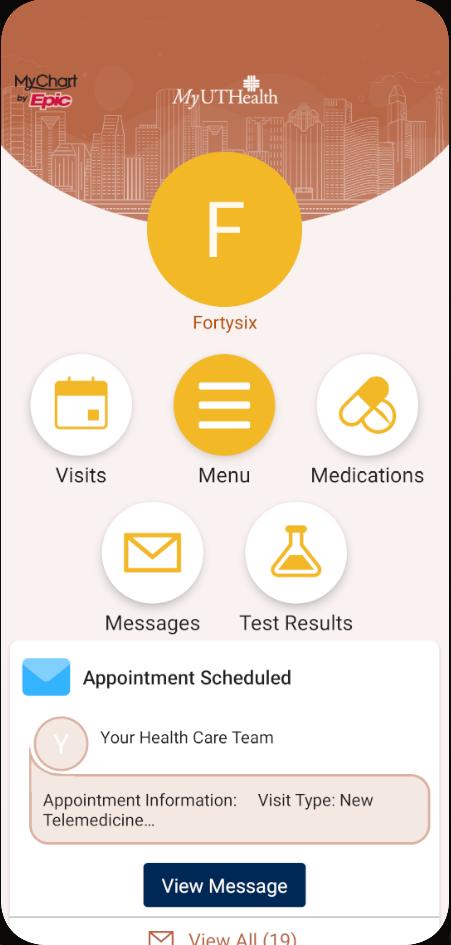
MyUTHealth: a patient app on an existing records system
What we built
We built MyUTHealth, a patient portal app for a health provider, for Android on its existing records platform through HL7 FHIR APIs. Patients can ask for appointments, check test results and send secure messages to their care team.
Downloaded 50,000+ times from Google Play and rated 4.4 stars across 750+ reviews
Clinic records system: separate tools brought together
What we built
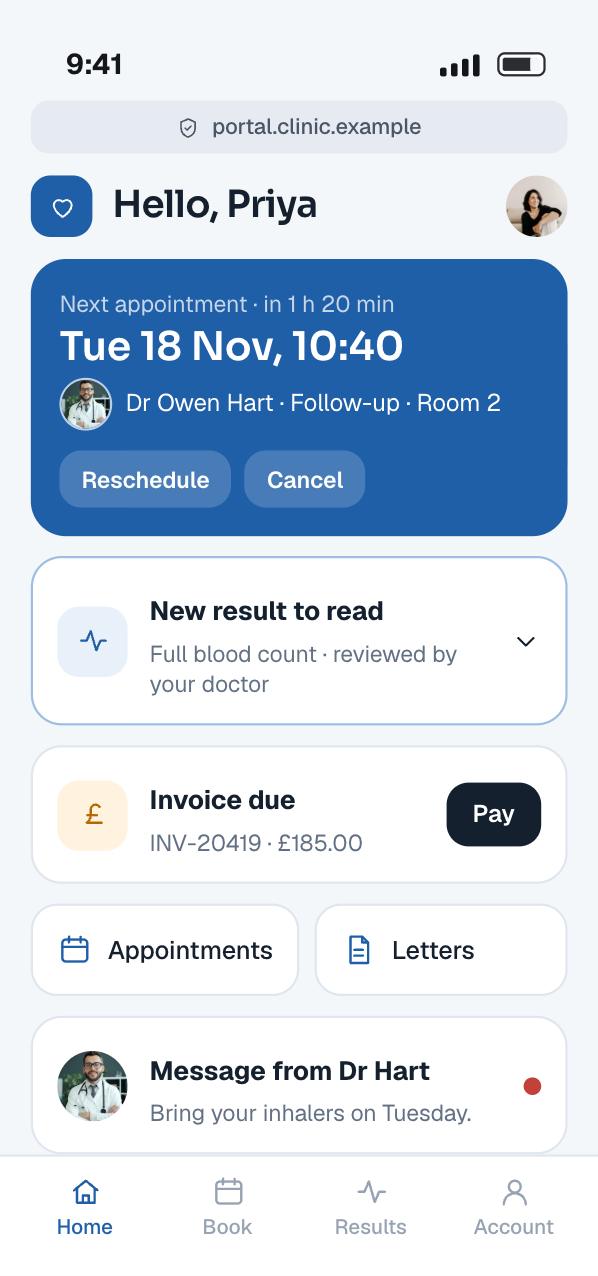
With the clinic records system we built, registration, the medical record, consultation notes, the diary and billing sit in one system rather than in separate tools and paper files. Laboratory results come in over HL7 instead of being typed again, and the system runs on React and Java with SQL storage, hosted on AWS.
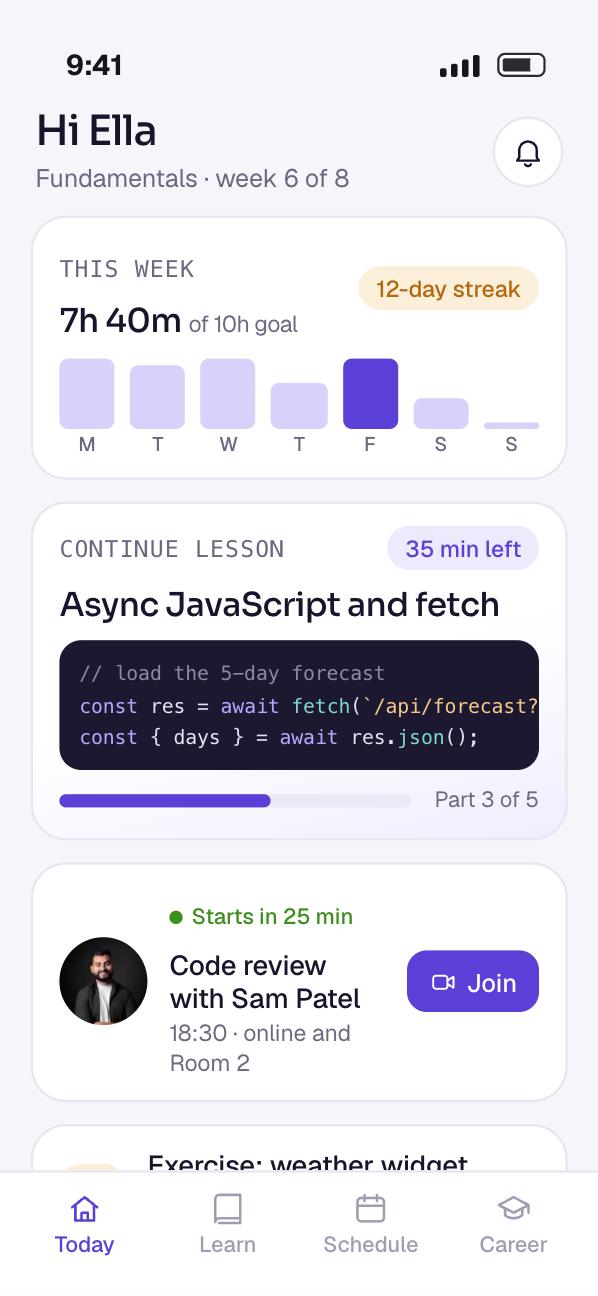
This coding school’s old website made its courses hard to follow, and learners moved between separate tools for prep work, live lessons and campus days. We built a React and Next.js web platform, with a React Native app, that joins those stages in one learning hub and tracks admissions automatically, with Node.js and PostgreSQL behind it.
“Our patients needed the portal in their pocket: requesting visits, reading test results, reordering medicines and messaging their care team. AppAgentix built the Android app on our Epic MyChart system, careful where it matters: secure sign-in, no clinical detail on the lock screen, and patients choose what fitness data they share. The app has passed 50,000 downloads with 4.4 stars from over 750 reviews, and every release was tested before it reached our patients.”
“We needed one platform for the whole journey: comparing courses, booking a call, applying, then learning. AppAgentix built the website, the learning hub and the mobile app. Admissions now move 45% faster and information calls are up 38%. More than 5,000 learners use it, and 92% complete their course. They understood how a school actually runs, not just how to write the code.”
“We wanted one streaming service that felt the same on phone, tablet and TV, whether people watch free with adverts, subscribe or rent a film. AppAgentix built the apps for iPhone, iPad, Android and Apple TV and the service behind them. They got the hard parts right: playback that starts quickly, a home screen that works with a TV remote, and billing that stays correct. The Android app has passed 50,000 downloads.”
Which module goes first: the slice order worksheet
In week 2 we score each module on three counts, then set the build order. Filled in for an illustrative example, not a client: a small physiotherapy clinic’s five-module system on an out-of-support server.
ExampleSlice order worksheet, clinic systemAppAgentix
Module
Change requests last year
If it fails for a day
Tables it shares
Build order
Reminders
14
Texts go out late; staff can phone
2
1st: changes most, fails safest
Reporting
9
Month-end figures wait a day
5, read only
2nd: reads data, never writes it
Bookings
6
The front desk cannot book
4
3rd: once two modules prove the method
Invoicing
3
No bills go out and cash stops
6
4th: costliest error, so built on tested code
Patient records
1
Clinicians lose treatment notes
9
5th: moved with the final data copy
Our rule: build first what changes most and breaks least, and move last whatever every other module reads. Modernise when the old system costs more to keep over three years than the new one costs to build and run.
Software projects slip when the scope is vague. Ours start with a two-week discovery that ends in one fixed price.
The parallel-run difference report you read before switchover
Every difference from two weeks of side-by-side running, for the same clinic.
ExampleParallel-run difference report, weeks 11 to 12AppAgentix
Check
Old system
New system
Result
Notes
Bookings made
612
612
Pass
Same patients, times and clinicians
Takings, 10 working days
Matched
Matched, was 2p short
Pass after fix
New code split each six-session package into six sessions, losing 2p; the last session now carries it
Card payments matched to bookings
548
548
Pass
Checked against the card terminal’s daily report
Patient balances
238 accounts
238 accounts
Pass
Credit notes included
Overdue payment reminders
57
61
Open
New system counts day 30 as overdue, old one day 31; your practice manager picks the rule
Switchover is booked only when no row is open, or you accept an open row in writing.
Legacy application modernisation, week by week
More than 95% of our projects are delivered on or before the agreed date. Around 15% of survey respondents in the DSIT review could not even estimate the size of their legacy estate, so the assessment starts by counting yours.
Week1234567891011121314monthly
01Assessment
02Make it safe
03Build the first slice
04Run in parallel
05Switch over
01Weeks 1 to 2
Assessment
We review the code, database and hosting, interview two or three daily users, score each module and price each route.
You receive: A report with the risks ranked, the build order, the three-year cost and a fixed quote.
02Weeks 3 to 4
Make it safe
The code moves into a repository in your name, one backup is restored as a test, and tests go around key behaviour.
You receive: A restore log, a test suite and a runbook.
03Weeks 5 to 10
Build the first slice
Modules are wrapped or rebuilt in two-week sprints, each ending with a demo on a copy of your data.
04Weeks 11 to 12
Run in parallel
Both systems handle the same work for two weeks; the difference report lists every mismatch.
05Weeks 13 to 14
Switch over
You approve the date and we run the final data copy, then the old system stays read-only for a month.
You receive: Migration counts you check yourself, and a handover session.
What we would say no to
Each refusal protects your data or your budget. 74% of UK businesses back up data securely via a cloud service (DSIT Cyber Security Breaches Survey 2025/2026). A backup counts once it has been restored.
Code changes before a restore test
Nothing changes until one backup has been restored on a test machine.
Switching with an open row
Switchover waits until every difference row is settled or you accept it in writing.
AI on a rule nobody can write down
An AI feature cannot be tested against an unwritten rule, so we write the rule first.
Taking over without access
We need admin access to the database and hosting before the quote is fixed.
Rebuilding a quiet module
A module with no change requests in a year, on supported software, is left alone or wrapped.
A whole-system price on day one
The fixed figure follows the assessment, because the state of the data sets the cost.
Legacy software modernisation services, line by line
01 / 06
First call
A written view on scope and price within two working days. 30 minutes, free.
02 / 06
Assessment
Risks ranked, module scores, three-year costs and a fixed quote, credited if you continue. 2 weeks.
03 / 06
First legacy modernisation stage
Making it safe, one slice or a whole small system like the clinic’s, a parallel run and its data migration. 8 to 14 weeks.
04 / 06
Full legacy system replacement
A system too big for one stage: several stages or a full rebuild, each repeating weeks 5 to 14. 4 to 8 months.
05 / 06
AI feature on one workflow
Tested on your cases, with the running cost on the quote. 6 to 10 weeks.
06 / 06
Support and running
Billed monthly: fixes, security updates and a monthly report. Minimum 3 months, then 30 days’ notice.
Estimate your first modernisation stage in a minute
Pick what the stage replaces.
Included to start: Assessment, making it safe, one module wrapped, parallel run, migration. 8 to 9 weeks.
A sample scope: the build and what runs after it
Every line for the clinic example, and who bills it.
ExampleScope lines, clinic systemAppAgentix
Line
One-off
Each month
Billed by
First stage, five modules
One fixed figure
None
AppAgentix, assessment included
Fixes for 3 months after switchover
Included
None
AppAgentix
Support plan, after those 3 months
None
Monthly plan
AppAgentix, 30 days’ notice
Hosting in your account
None
Cloud bill
Your cloud provider
Licences and exit fees
None here
None
Each vendor, listed when they apply
An AI feature adds its own running-cost line here.
What our software modernisation services include and exclude
Ask every supplier for the second half.
Documents
Included: a system map, a data dictionary for the tables we touch, and a runbook.
Tests
Included: automated tests for the behaviour we change, plus the difference report.
Data migration
Included: one migration, rehearsed on a copy before switchover.
Ownership
Included: the repository, hosting account and domain sit under your organisation from the first commit, with us as a user you can remove.
Dirty data
Not included: we report duplicated or missing records and quote the clean-up separately.
Vendor fees
Not included: licences, API charges and the old supplier’s exit fees, listed on the quote.
Staff time
Not included: a named contact of yours for about two hours a week.
How a UK rule changes the project
Project guidance, not legal advice.
Rule or dateWhat changes in the project
01Rule or dateUK GDPR security principle
What changes in the projectA backup is restored on a test machine before any code changes
The ICO asks for measures that can restore personal data after an incident.
02Rule or dateUK GDPR Article 35, impact assessments
What changes in the projectThe assessment report says whether the change needs an impact assessment
03Rule or dateUK GDPR storage limitation
What changes in the projectRecords past your retention period are left out of the migration
04Rule or dateVendor end-of-support dates
What changes in the projectUnsupported components are replaced or isolated in weeks 3 to 4
Per the NCSC, only retiring an obsolete product removes its risk in full.
05Rule or dateCyber Essentials control on security updates
What changes in the projectA dated list of each component and its update status, ready for a customer’s questionnaire
Need a figure for the board? Get a written view of scope, time and price within two working days, yours to keep.
The ten questions discovery starts with: users, the jobs they need done, systems to connect, rules, deadline and budget. Fill it in, attach nothing else, and the first call starts at the right place.
It is making old business software safe, supported and easier to change, without losing its data or rules. The work ranges from new hosting, through a new interface, to a module-by-module rebuild.
How to modernize legacy systems?
Assess, make the system safe, then change one part at a time. With us: a two-week review, a restored backup and automated tests, modules rebuilt in the worksheet’s order, and a parallel run before each switch.
Why do companies still use legacy systems?
Because it still does its job, and replacing it carries cost and risk. Its code holds years of unwritten business rules, and a failed switch puts invoicing or bookings at risk.
Why do companies not replace all of their legacy systems?
Because some parts do not earn a rebuild. In our week 2 scoring, a module with no change requests in a year, supported software and few shared tables is left alone or wrapped.
What are the 5 R's of modernization?
Lists differ, so there is no single set of five, while AWS lists seven: retire, retain, rehost, relocate, repurchase, replatform and refactor. Refactor rewrites the code, repurchase buys a product, and retire switches it off.
How much does it cost to maintain software?
Add up hosting, licences, fixes and the staff time lost to workarounds. Our support plan starts at £750 a month excluding VAT, and the assessment totals your current system’s three-year cost.
Can you give me an example of legacy modernization?
Take the clinic above, where reminders are rebuilt first and patient records move last. Both versions handle the same bookings and takings for two weeks, and the new one takes over once every difference is settled.
How do you fix outdated software?
Find which part is out of date: the operating system, the database or the code. Replace unsupported parts first, add backups and tests, then change the code in small steps.
Let’s make your software project the one that ships on time.
More than 95% of our projects are delivered on or before the agreed date. About 60% of our clients come back for a second project.
What happens next
1We reply within 30 minutesEvery day of the year. A developer at our software development company, not a sales team, reads your brief.
2A 30-minute callWe ask about users, deadlines and the systems you already run.
3A written view in two working daysScope, timeline and a price range, yours to keep.
Thank you. Your brief is in.
A developer, not a sales team, reads it. We reply within 30 minutes, from info@appagentix.co.uk.
We use cookies to run this site and, with your permission, to understand how it is used. Cookie policy · Privacy policy
Let’s make your software project the one that ships on time.
More than 95% of our projects are delivered on or before the agreed date. About 60% of our clients come back for a second project.
What happens next
1We reply within 30 minutesEvery day of the year. A developer at our software development company, not a sales team, reads your brief.
2A 30-minute callWe ask about users, deadlines and the systems you already run.
3A written view in two working daysScope, timeline and a price range, yours to keep.
We wanted one streaming service that felt the same on phone, tablet and TV, whether people watch free with adverts, subscribe or rent a film. AppAgentix built the apps for iPhone, iPad, Android and Apple TV and the service behind them. They got the hard parts right: playback that starts quickly, a home screen that works with a TV remote, and billing that stays correct. The Android app has passed 50,000 downloads.
Michael S.CEO and Co-Founder, Play Now Media
Thank you. Your brief is in.
A developer, not a sales team, reads it. We reply within 30 minutes, from info@appagentix.co.uk.
 WCAG 2.2 AAAccessibility
 FigmaScreens and clickable prototypes you can test
 ReactThe library for web and native user interfaces
 Next.jsThe React framework for web applications
 TypeScriptTyped JavaScript that catches errors early
 Anthropic ClaudeClaude Fable 5.2, Opus 5.5, Sonnet 5.5, Haiku 5.5
 Google GeminiGemini 4 models for text, images, audio, video and PDF
 Node.jsJavaScript runtime for scalable network applications
 PythonLanguage for web development and scientific work
 PostgreSQLOpen-source database; pgvector adds vector search
 RedisIn-memory store for caching and live messages
 AWSCloud hosting with a London region
 Google CloudCloud hosting with a London region
 DockerPackages and runs an app in a container
 TerraformCloud set-up written as code, repeatable
 GitHub ActionsCI/CD platform to automate build, test and deployment
 SentryCaptures errors and alerts you with full context
 Web app developmentWeb platforms, portals and dashboards.
 Custom CRM and ERPBusiness systems shaped around how you work.
 Maintenance and supportUpdates, monitoring and OS releases.
 MVP developmentA first version for users and investors.
 DevOps and CI/CDAutomated builds, tests and releases.
 Product engineeringWeb platforms, admin panels and APIs.
 PricingWhat apps and AI agents cost, in pounds.
 Healthcare softwareRecords, scheduling and clinical platforms.
 Insurance softwarePolicy, claims, underwriting and broker platforms.