ChatGPT
 Claude
 Perplexity

Contents
A free app makes money when someone other than the downloader pays, or when a few users pay later. Some users buy an upgrade or a plan. Advertisers pay for views. Shops and booking apps sell goods and services, and companies pay for staff access.
- Ads: Advertisers, through a network.
- Subscription: Users, monthly or yearly.
- In-app purchase: A one-off buy.
- Goods and services: Food, rides, retail or bookings.
- Business customer: A company, for its staff.
- Sponsorship or affiliate: A brand.
Free, freemium, paid and paymium apps compared
| Price to download | Where the money comes from | A typical case | |
|---|---|---|---|
| Free | Free | Ads, goods and services sold in the app, or content the user bought elsewhere | A food ordering app, or a magazine reader |
| Freemium | Free | Optional upgrades, extra content or a plan, bought inside the app | A habit tracker with a paid tier |
| Paid | A one-off price | The download itself, with no later charges | A premium tool sold once |
| Paymium | A one-off price | The download, plus optional in-app purchases | A paid game with extra levels to buy |
A hard paywall, asking for payment before use, turns more downloads into payers than freemium, though year-one retention is nearly the same.
Why free does not mean no revenue
In 2025, $1.1 trillion of the sales through Apple's App Store ecosystem was physical goods and services: groceries, food delivery, retail and travel. Digital goods and services came to $149 billion. On Google Play, Google says 97% of developers pay it nothing to distribute their apps.
The store rules explain the split. Apple's guideline 3.1.3(e) says goods or services used outside the app are paid another way, such as Apple Pay or a card. Google keeps physical goods outside Play billing too. That is why many free apps make money for a business rather than as one: a shopping, delivery or booking app is the way in.
- $1.4 trillionbillings and sales through the App Store ecosystem in 2025
- Over 90%of those billings and sales paid no commission to Apple
- $151 billionin-app advertising revenue from ads developers placed, more than all digital sales
How free apps make money, model by model
| Who pays | What the store takes | |
|---|---|---|
| Ads | Advertisers, through an ad network that pays you | Paid outside the store |
| Subscription | Users, monthly or yearly | Apple 30% in a subscriber's first year, then 15%. Google Play UK 10% plus 5% |
| In-app purchase | Users buying content, a feature or game currency | Apple 30%, or 15% on its Small Business Program. Google Play UK 10% plus 5% on early earnings (fee table below) |
| Physical goods or services | Customers buying food, rides, retail or bookings | Nothing on the goods; your card provider bills its own fee |
| A business customer | A company, for its staff or students | Outside the store, for apps sold only to organisations |
| Sponsorship or affiliate | A brand, for placement or referrals | Paid outside the store |
What are the different types of app monetization models?
What each way to monetise asks of the free app, and the rule that shapes it.
In-app advertising
In a free app, an ad network pays you for views and taps. Under rule 2.5.18 of Apple's App Review Guidelines, full-screen ads must be labelled as ads, with an easy close button, and never targeted on health data.
Subscriptions
A plan that renews monthly or yearly, for apps people return to. Apple pays you 70% of the price in a subscriber's first year and 85% after, so subscribers kept past a year earn you more.
In-app purchases
A feature unlocked for good, or something spent and bought once more, such as extra lives. Apple's rule 3.1.1 sends these through in-app purchase.
Goods, services and bookings
The free app is the shop counter. Food, rides and bookings are paid by card or Apple Pay, outside store billing, so no store fee applies. The money is in the order, not the download.
Sponsorship and affiliate links
A brand pays for a featured spot, or pays a share when a user buys through your link. It suits a free app whose audience is narrow, such as runners or new parents. Mark paid placements clearly.
User data, inside the rules
Apple's rule 5.1.2 lets an app share data with third parties only to improve the app or serve ads, and only with permission. The ICO's consent rules cover apps too. Use data to improve the app, not to sell.
What a sale leaves a free app that sells upgrades
| Store fee | Share of the price you keep | |
|---|---|---|
| Apple standard, or a subscription's first year | 30% | 58.3% |
| Apple Small Business Program, or a subscription after a year | 15% | 70.8% |
| Google Play UK: subscription, or the lower fee tier | 10% + 5% | 70.8% |
| Google Play UK standard: new install | 20% + 5% | 62.5% |
| Google Play UK standard: existing install | 25% + 5% | 58.3% |
Fees as of November 2026; pence rounded. Google charges and pays the VAT on UK Play billing sales as merchant of record, and GOV.UK says a platform selling digital services accounts for it. Ask your accountant about your own VAT position.
Google Play's UK fees changed on 30 June 2026
| Service fee | Billing fee | In all | |
|---|---|---|---|
| First $1M a year | 10% | 5% | 15% |
| Subscriptions | 10% | 5% | 15% |
| One-off sale, new install | 20% | 5% | 25% |
| One-off sale, existing install | 25% | 5% | 30% |
UK users, as of November 2026; the billing column covers Play Billing sales. Apple's Small Business Program needs enrolment; without it, Apple takes 30% of one-off sales and a subscription's first year.
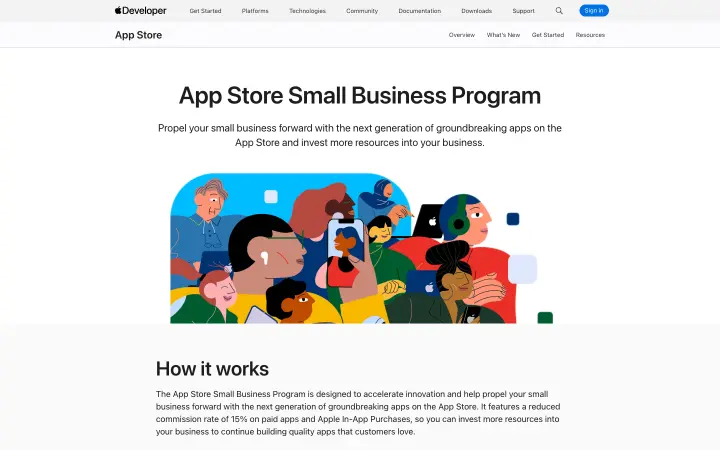
 Apple App Store Small Business Program page, captured 15 November 2026.
 Google Play Console about page, captured 15 November 2026.
How one subscription payment reaches the app owner
- The user subscribes: £4.99 a month, paid through Apple In-App Purchase or Google Play's billing system.
- VAT comes off: £0.83 is UK VAT, which the store accounts for on the sale.
- The store fee comes off: 15% of the £4.16 left: £0.62.
- You receive proceeds: About £3.53 per paid month on our worked figures. Your actual proceeds appear in App Store Connect's Payments and Financial Reports.
- The plan renews: If the user stays, it repeats next month.
How much money does a free app make?
The example below starts from five inputs: downloads, the share who open it daily, ad views, the share who pay and paid months. The app is an invented habit tracker on both phones, with sign-in, reminders and an admin panel. It is an example, not a client result.
RevenueCat's 2026 data gives two inputs. For the median subscription app from a Western European developer, 2 in every 100 downloads pay by day 35. In Western Europe, 55% of monthly payers renew the first time. Every other input is our assumption.
Reading up because you have a project in mind? Ask the developers behind this guide how it applies to yours.
Book a free 30-minute callWhat the example free app costs in its first year
Example: the subscription version, excluding VAT.
How much money will my app make if it has 100,000 downloads?
| Against its first-year cost | |
|---|---|
| Ads only | Short |
| Subscription only, 15% store fee | Short |
| Subscription only, 30% store fee | Short |
| Ads and subscription, 15% store fee | Ahead |
| Ads and subscription, 30% store fee | Just ahead |
Ads: 5,000 daily users x 6 views a day for 365 days, at the assumed ad rate. Plan: 2,000 payers for 3.5 months each. Mix: ads from the 4,900 daily users who never pay, plus the plan. At 4.0% instead of 2.0%, the subscription version moves from short of its first-year cost to ahead of it. In discovery we cost your model: which way fits and what it adds to the build.
What type of app is most profitable?
Which free apps make money fastest turns on how often people open them and who pays.
Which model fits your app?
A utility or tool people open daily
Choose Ads. At the assumed ad rate and 6 views a day, about 8,100 daily users repay the ads version’s first year. Double the rate and it is about 4,100; halve it, about 16,200.
A habit, health or learning app used again and again
Choose Subscription. At a 15% fee, about 3,100 payers repay the subscription version’s first year: about 153,800 downloads at 2.0%. At 30%, about 3,700 payers and 186,700 downloads.
A shop, booking or delivery app
Choose Sell the goods or service. No store fee on the goods, so the margin on every order goes towards repaying the build.
Companies pay for their staff or students
Choose Bill the business. Apple's guideline 3.1.3(c) allows access bought outside the app for apps sold only to organisations.
A game or content app
Choose In-app purchases plus ads. Spending varies too widely for one threshold from our sums.
A revenue check to fill in before you build
Fill in the second column to test whether your free app can earn money.
- Downloads in year one: Habit tracker example: 100,000. Note: From your launch plan
- Daily users: Habit tracker example: 5,000 (5%). Note: Assumption
- Ad views per daily user: Habit tracker example: 6 a day. Note: Assumption
- Earnings per 1,000 ad views: Habit tracker example: Assumed. Note: Open: set after an ad network test
- Share who pay: Habit tracker example: 2.0%. Note: RevenueCat 2026, median for Western European developers
- Monthly price and store fee: Habit tracker example: The plan above, at 15%. Note: Small Business Program, or Google Play UK
- Paid months per payer in year one: Habit tracker example: 3.5. Note: Assumption
- Income in year one: Habit tracker example: Ads plus plan, after VAT and fees. Note: From the lines above
- First-year cost: Habit tracker example: Build, support and hosting. Note: Excluding VAT
- Result, ads and plan: Habit tracker example: Ahead. Note: Pass, but thin
- Result, plan only: Habit tracker example: Short. Note: Without ads: add ads or plan for year two
- One more point of conversion: Habit tracker example: About 1,000 more payers. Note: At 100,000 downloads
An example, not a client record.
What each way to monetise adds to the build price
| Days of work | |
|---|---|
| Ads: network, consent screen and test ads | 4 to 8 |
| One subscription plan with a free trial | 8 to 14 |
| Ads and a subscription | 12 to 22 |
| One-off in-app purchase | 8 to 13 |
| Card or Apple Pay checkout for goods or bookings | 5 to 9 |
| Sponsorship or affiliate links | Set in discovery |
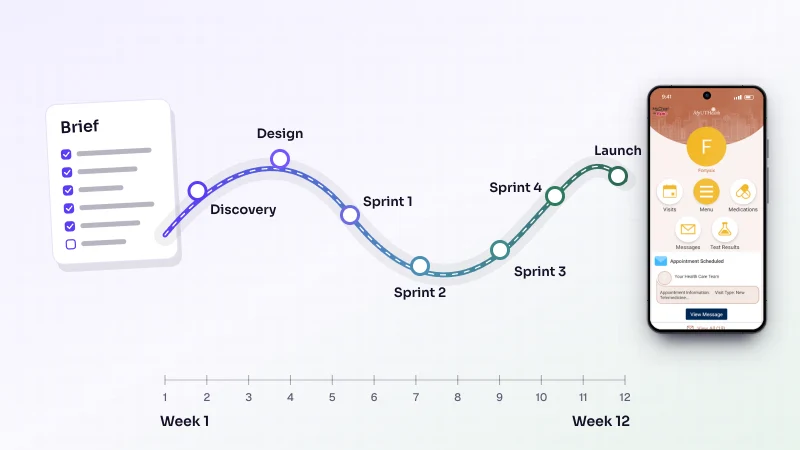
Our MVP builds, scoped to one model, take 8 to 14 weeks.
UK rules that change how a free app earns
| Rule | Build decision | Note |
|---|---|---|
| VAT on digital sales through an app store | Prices in pounds with VAT included; income modelled after VAT | |
| PECR consent for storing or reading device data | A consent screen before any ad network starts | The ICO says the rule covers apps. Consent must be freely given, specific and informed. |
| Apple App Tracking Transparency | Ask before tracking; plan ad income for people who say no | iOS 14.5 and later. |
| Apple guideline 3.1.1: paid features in the app | Sell upgrades by in-app purchase, with a restore button | |
| Apple 3.1.3(e) and Google payments policy: physical goods | Take payment for goods and bookings by card or Apple Pay | |
| Apple Small Business Program | Enrol early, so sales pay 15% rather than 30% | For new developers or those with up to $1 million in proceeds the year before. Apple adds up the proceeds of every account you own or control, or that owns or controls yours, so list them when you enrol. |
- 10.7%of downloads pay by day 35 behind a hard paywall, against 2.1% for freemium
- 31%of subscription cancellations on Google Play are billing failures, against 14% on the App Store
- 55%of three-day trial cancellations happen on the first day
How to make a free app profitable?
Six habits that help a free app make money it would otherwise lose. Figures: RevenueCat State of Subscription Apps 2026.
Price on what reaches you
A free app's plan leaves 70.8% of its price at best after VAT and a 15% fee. Base prices and forecasts on that.
Enrol in Apple's 15% programme early
Apple's Small Business Program needs sign-up. On an Apple sale, enrolling keeps 70.8% of the price instead of 58.3%.
Give the free trial enough days
Trials of 17 to 32 days turned 42.5% of trial users into payers at the median, against 25.5% for trials of four days or less.
Show the value in the first session
Most people who cancel a three-day trial do it on the first day. Let the app prove its main job before the paywall asks for anything.
Recover failed renewals on Android
Nearly a third of Google Play subscription cancellations are failed payments, not choices. Prompt the user to update their card when a renewal fails.
Sell the removal of ads
A paid plan can offer the free app without its ads. In Black Movies & TV, a plan lets viewers watch ad-free.
 RevenueCat State of Subscription Apps 2026 page, captured 15 November 2026.
Ready to turn the plan into a price? Get scope, timeline and a price range in writing within two working days.
- 30 min to reply to a new enquiry
- 2 days to a written view of scope, time and price
- 95%+ delivered on or before the agreed date
Free apps we have built
A few examples from the many apps we have built, and the ways each one brings in money.
Media and streaming
Black Movies & TV: free with ads, a plan or a rental
- 50,000+downloads of the Android app on Google Play
- 4platforms listed: iPhone, iPad, Android and Apple TV
- 3ways to watch: free with ads, a monthly or yearly plan, or a single rental
We built Black Movies & TV, a streaming app for films and documentaries from Black creators. Viewers can watch free with ads, take a monthly or yearly plan, or rent a single film. On the TV app, our team put all three choices on one film page: subscribe and watch ad-free, rent that film, or play it with ads. A small lock marks titles that need a plan or a rental, so viewers see what is free before they tap. A paid film opens only after the purchase check confirms payment, and a restore option brings back eligible purchases on a new phone.
Read the Black Movies & TV case studyMedia and streaming
A streaming service app: ads, plans, single titles and points
We built a streaming service for phones and TVs with four ways to watch: free with ads, a monthly or yearly plan, one title bought, or points earned in the app.
Read the Streaming service app case studyEV charging
Tiger Charge: a free app that is paid per charge
- 10,000+downloads on the Google Play Store
- 4.1 starsaverage rating from drivers
- Over 40%of charging sessions start in the app with no call to the support team
We built Tiger Charge, a free Android app for electric car drivers. They start a charger from the phone and pay from a prepaid wallet. The money is in the charging, outside store billing.
Read the Tiger Charge case study
When a free app is the wrong choice
Free apps make money only at scale, as the thresholds above show. With a few thousand users, a free app will not repay its build in year one.
Charge the firm when your users are a company's staff; ads will not fund a team tool. Charge once when the app does one job once. An app that supports a business you already run need not earn money itself. Judge it on the orders or bookings it brings.
Next step: cost the model before you build the free app
The short answer to "how do free apps make money?" is: from whoever values the users most. Bring your filled revenue check to discovery. Discovery takes 2 weeks, and its fee comes off the build price.
Every build includes 3 months of fixes after launch. Support plans run monthly, with a 3-month minimum and then 30 days' notice. Accounts are in your name. If we do not deliver what the written scope promises, we refund what you paid for the undelivered work within 7 days.
Questions about how free apps make money
Are free apps profitable?
Some are. Yet most money moving through apps is not app revenue: most of what Apple counted for 2025 was goods and services. In our example, a free app with 100,000 downloads repaid year one only with ads and a plan.
Do free apps with no ads make money?
Yes. They earn from upgrades, subscriptions, goods and services, or a business that pays. A shop or booking app pays no store fee on its goods. A Google Play UK subscription pays 10% plus a 5% billing fee, as of November 2026.
Can a free game make money?
Yes. Apple lists consumables, such as extra lives or gems, as an in-app purchase type: players use them up and buy again. Many games add ads. Apple takes 30% of those purchases, or 15% on its Small Business Program, as of November 2026.
What is the best way to monetize an app?
The best way to monetise an app is the model that matches who already pays: users, advertisers, customers buying goods, or a business. A subscription suits apps people return to, and Apple pays you 70% in a subscriber’s first year, then 85%. Ads add 4 to 8 days to our build, and the ad network pays you outside the store.
What is the easiest app to monetize?
In our view, an app that already sells goods or bookings. It pays no store fee on them and needs only a card or Apple Pay checkout, 5 to 9 days of work with us. Ads are quick to add but need thousands of daily users.
Plan a first version around one model
When does a free app start to earn back its cost?
It turns on audience, not time. Our example app, with 100,000 downloads, repaid year one only with ads and a plan; a plan alone needed about 153,800 downloads. In our view, fund a year of running costs.
Does owning an app make money?
Only if enough people use it and someone pays. Owning an app also costs money each year: support, hosting and Apple's annual developer fee. Fill in the revenue check above before you build, and plan for year two.