ChatGPT
 Claude
 Perplexity

Contents
Choosing how to make an app: which route fits
Pick the first row that is true for you. We build apps as an agency and also hire out engineers by the day. Those are two of the routes below, so these thresholds are our own view, set from what each route costs at our rates and where it stops working.
Which of these is true for you today?
you have a small budget and want to test the idea
Choose a clickable prototype from an AI app builder or a no-code tool. A small budget buys a few days of work, while our smallest store-ready build is about 30 days.
one simple job, no payments, and a form plus a spreadsheet would serve your first 50 customers
Choose a no-code builder or a mobile website. Move to a custom build at 50 regular customers, a second type of user, or card payments.
you have a technical lead who reviews code, and at least 10 days of defined work
Choose a freelancer by the day. You pay for each day of work. Without a reviewer, nobody checks the work before you pay.
one main job, one type of user and card payments
Choose an agency MVP at a fixed price. With us it takes 8 to 14 weeks, and the bakery app sits in this row.
two types of user or several integrations
Choose a full app, with an agency first. That takes 4 to 8 months with us, and each link to a system you already run adds about 5 to 8 days.
one engineer would be busy every week for a year
Choose an in-house team. Our view: price a salaried hire against a full working year at our hire rate.
Where each route stops working
| No-code or AI builder | Freelancer | Agency | In-house team | |
|---|---|---|---|---|
| One month of work | A monthly plan fee | 20 days at our hire rate | Inside the fixed price of an MVP | A salary, recruiting and a lead |
| Our trigger to move on | 50 regular customers, a second user type, or card payments | Work for more than one person, or no reviewer | A scope that changes every week | Less than a year of steady work |
| Who owns code and accounts | The builder hosts it: check code export | Whatever the contract says | With us, your company, from the first commit | You do |
| Ask before paying | Can I publish from my own store accounts? | Who reviews the code and covers a sick day? | Is the price fixed for a written scope? | Who leads the team for six months? |
Day rates and prices exclude VAT, as of November 2026.
Can I pay someone to build an app for me?
Yes. Our view: whoever you pay, get these seven things in writing before the first invoice.
- A fixed price for a written scope. Anything outside it is priced in days before it is built. You pay by milestone
- Whose name every account is in. Store, code, hosting and payment: your company’s, from day one
- Who owns the source code. The repository sits in your account, so you hold every version
- What the hand-over contains. Every login, the design files, the release steps and a list of open faults
- The test report before launch. Named phones and an owner for every open row, like the bakery report below
- Who pays the store and hosting bills. Your company card, so nothing lapses if the supplier stops
- What happens if work stops. A refund rule for undelivered work, with a deadline. Ours is 7 days
Can ChatGPT build me an app?
It can write code and a clickable prototype, and if you are working out how to create an app on a small budget, that is a sound first step.
Our view: it does not open store accounts in your name, set up payments, review security or check data protection.
Our trigger for moving to a custom build is any one of four signs. You pass 50 regular customers, add a second type of user such as shop staff, or need card payments, or the app must link to a system you already run.
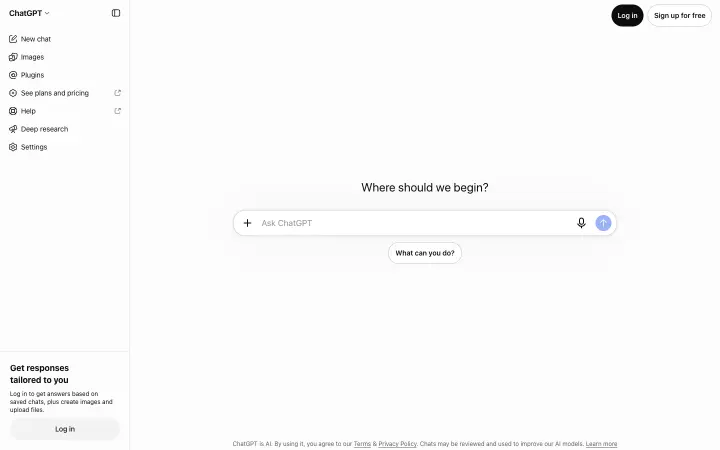
 ChatGPT home page, captured 15 November 2026.
The bakery app brief, filled in
The bakery wants customers to order the night before and collect without queuing. This is its brief at the end of week 2, with one row cut and one still open.
| Field | Answer | Status |
|---|---|---|
| The one job | A customer orders by 10pm and collects from 7am, without queuing | Agreed |
| Who uses it | Customers on both phones; staff on a counter tablet | Agreed |
| The five screens | Menu, basket, collection slot, payment and my orders | Agreed |
| Not in version one | Delivery, loyalty stamps, gift cards, custom cakes | Decided: loyalty stamps cut in week 2 to keep launch in week 12 |
| Data it holds | Name, email and orders; card details stay with the payment provider | Agreed |
| Payments | Card and Apple Pay, for goods collected in the shop | Agreed |
| Rules that apply | Privacy notice, ICO fee, Delete my account, data safety form | Agreed |
| Children’s code | Are under-18s likely to use the app? | Open: needs owner. The bakery owner answers by week 3 |
| The number that proves it works | 40 customers order twice in the first month | Agreed |
| Budget | The fixed price below, excluding VAT, discovery counted in | Agreed |
| Launch date | Week 12, on the App Store and Google Play | Agreed |
| Accounts | Store, code, hosting and payment accounts in the bakery’s company name | Agreed: Apple enrolment started in week 1 |
Signed in week 2. Each open row names who closes it and by when.
How much does it cost to develop an app in the UK?
With us, an MVP takes 8 to 14 weeks and a full app 4 to 8 months, each at one fixed price after discovery. The bakery example shows what it costs to make an app line by line, each line priced from days of work at our day rate. It builds for both phones because StatCounter put iOS at 50.13% and Android at 49.86% of UK mobile and tablet page views in October 2026.
Price your own app on our cost estimator.
- Base: discovery, design, the ordering journey, email sign-in, counter screen, analytics and store launch£17,500
- Both phones from one codebase£3,000
- Card or Apple Pay checkout£3,500
- Booking or collection slots£3,000
- Order-ready notifications (triggered)£5,000
Fixed price for this scope, 12 weeks£32,000
Estimate your first app in a minute
Pick what your first version needs, and each option is priced from its days of work at our day rate.
Reading up because you have a project in mind? Ask the developers behind this guide how it applies to yours.
Book a free 30-minute callA 12-week plan to make an app, week by week
The bakery app’s plan, with about three hours a week of your time. It delivers the scope priced above in 12 weeks.
1.DiscoveryWeeks 1 to 2
We write the brief with you and price every line, while you start Apple enrolment..
You receive: The signed brief, a prototype and a fixed price.
2.Design and customer testWeeks 2 to 4
Ten regular customers try to order on the prototype, and you invite them..
You receive: Final screens.
3.Sprint 1: menu and basketWeeks 4 to 5
Sign-in, the menu and the basket, while you send prices and allergen notes..
You receive: A working build on your own phone.
4.Sprint 2: checkoutWeeks 6 to 7
Card and Apple Pay through a payment provider in your name, and you open that account..
You receive: Test payments in your provider’s dashboard.
5.Sprint 3: slots and alertsWeeks 8 to 9
Collection slots with a cap on each, and the order-ready alert, while you set the opening hours..
You receive: Orders that land in the right slot.
6.Sprint 4: counter screenWeeks 10 to 11
The staff tablet: today’s orders and a Ready button, while you run a mock morning with staff..
You receive: A counter screen your staff have used.
7.Test run and launchWeeks 11 to 12
The test report below, which you read, then submission under your accounts. As of November 2026, Apple’s App Review page says it typically reviews 90% of submissions in under 48 hours and at least 50% in under 24 hours. So week 12 keeps two days for it..
You receive: Live listings and every login.
- Discovery: weeks 1 to 2
- Design and customer test: weeks 2 to 4
- Sprint 1: menu and basket: weeks 4 to 5
- Sprint 2: checkout: weeks 6 to 7
- Sprint 3: slots and alerts: weeks 8 to 9
- Sprint 4: counter screen: weeks 10 to 11
- Test run and launch: weeks 11 to 12
What moves the price and the launch date
When you pay someone to make an app, the price moves in days. Apple and Google sign-in would add 4 to 8 days to the bakery app. One phone instead of both would save the same 4 to 8 days.
Dates move in weeks, and a week costs more than most features. A two-week slip with two engineers is 20 days of work, all at our hire rate. More than 95% of our projects are delivered on or before the agreed date. Our view: the slip most worth avoiding is a store account opened late, because no code can speed it up.
Google’s Play Console Help sets one such wait for personal accounts created after 13 November 2023. Each app on such an account needs a closed test with at least 12 testers opted in continuously for at least 14 days. Started in week 11, it moves a week-12 launch to week 13 at the earliest.
Week 1: who opens which account, and in what order
Whoever you pay to build the app, these accounts belong to your company, so open them in this order, before any code is written.
- First, Apple, opened by a director. The person enrolling needs legal binding authority. Use the company’s legal name: Apple does not accept trade names or branches. Apple also checks a company through its D-U-N-S Number, so look yours up or request one in week 1
- Sole trader? Your own name goes on the store. Apple lists your personal legal name as the seller
- Second, Google Play, same person, same week. If it is a new personal account, plan the 14-day closed test above
- Third, the payment provider. The owner opens it and keeps the keys. Test payments run from week 6
- Fourth, the code repository and hosting. Log in once and check you can see both
- Then add us as users, never share the owner login. You can remove our access at hand-over
- Ask which Android version the build targets. Google Play requires new apps and updates to target Android 16 (API level 36) or higher since 31 August 2026
- Week 11: privacy link and data safety form. The brief’s data row gives the answers for Google’s form
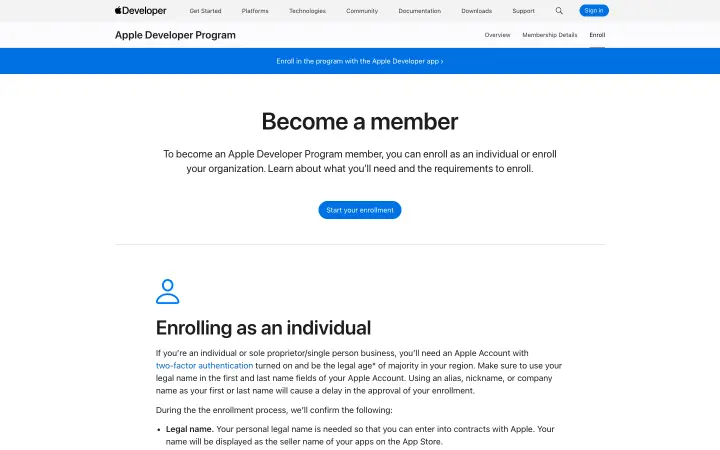
 Apple Developer Program enrolment page, captured 15 November 2026.
 Google Play Console about page, captured 15 November 2026.
UK rules and the screen each one changes
| Rule | What changes in the app | Note |
|---|---|---|
| Privacy information (UK GDPR) | A privacy notice link at sign-up and in settings | The ICO says it is due when you collect personal data. Apple also wants the link in the app. |
| Data protection fee (ICO) | No screen: it goes on the launch list | Payable unless exempt: £52 at tier 1, £78 at tier 2. |
| Children’s code | Sign-up and settings planned for younger users | The ICO says its 15 standards probably cover a service likely to be used by under-18s, even one not aimed at them. |
| Account deletion (App Store) | A Delete my account button in the app | Apple: an app that supports account creation must offer account deletion within the app. |
| Data safety form (Google Play) | No screen: a Play Console form matching what the app collects | The brief’s data row gives the answers for it. |
| Paying for goods (App Store) | A card and Apple Pay checkout, not in-app purchase | Apple’s rule 3.1.3(e): physical goods used outside the app must be paid by methods other than in-app purchase, such as Apple Pay or card entry. Bread collected in the shop is one. |
| Online Safety Act 2023 | Reporting and moderation screens, if users post or message each other | Its duties apply where users post content or interact. The bakery app does neither. |
The test report you should be sent before launch
This is the bakery app’s week 11 run on six real phones, sent before anything goes to the stores.
| Check | Phone | Result | What happens next |
|---|---|---|---|
| Order a loaf for 8am and pay by card | iPhone 15 | Pass | Nothing |
| The same order with Apple Pay | iPhone SE (3rd generation) | Pass | Nothing |
| Pay at the largest text size | Samsung Galaxy A54 | Pass after fix | The Pay button sat under the keyboard. Fixed in build 1.0 (12) and retested. |
| Signal lost after tapping Pay | Google Pixel 8 | Pass | One order, one charge. |
| The slot fills while the basket is open | iPhone 13 | Pass after fix | It showed as free. It now rechecks at payment and offers the next slot. |
| Notifications refused | Samsung Galaxy S23 | Pass | Order status still shows in My orders. |
| Delete my account | Google Pixel 8 | Pass | Data gone from the app and the counter screen. |
| Order path read by TalkBack | Google Pixel 8 | Open | Quantity buttons have no name. Fix due Tuesday of week 12, then retest. |
Signed by the tester and by you. The open row is on the main order path, so submission waits.
What we refuse to do when we build an app for you
Our rules, from where app projects go wrong.
- Open a store account in our own name. An app under a supplier’s account is the supplier’s to move
- Fix a price before discovery. Before it, you get a range in writing; after it, one fixed price
- Start sprint 1 before every line has a price. Building begins once the brief is signed
- Hide the work until the end. Each sprint ends with a build on your own phone, from week 5
- Collect data the brief does not list. Nothing outside the data row goes into the app
- Submit with an open fault on the main path. The bakery launch waits for the TalkBack fix
When not to build an app
Our view: wait to build an app if any of these three checks fails, because each one costs less to fail now than after the build has started.
First, a mobile website, a form plus a spreadsheet, or a no-code tool would serve your first fifty customers. A mobile website still meets them on the phone. Ofcom Online Nation 2025 found smartphones took 75% of UK men’s and 79% of UK women’s online time on personal phones, tablets and computers in May 2025.
Second, you cannot name one action and a number that proves demand, such as 40 customers ordering twice in month one. Third, fewer than 5 of 10 test users finish the main task unaided on a clickable prototype. Fix the prototype first.
Ready to turn the plan into a price? Get scope, timeline and a price range in writing within two working days.
- 30 min to reply to a new enquiry
- 2 days to a written view of scope, time and price
- 95%+ delivered on or before the agreed date
What it costs to run the app after launch
Once you make an app live, these costs run every month. Our support plans start at £750 a month, excluding VAT, and the cost page lists every plan.
Hosting
Servers, database and storage are a monthly bill, paid on your company card so nothing lapses.
Support plans
Three plans, Essential, Standard and Premium, with extra hours billed on top. The minimum is 3 months, then 30 days’ notice.
Fixes and changes
Faults in the agreed scope are fixed free for 3 months. A new feature is priced in days: a link to the shop’s till system is 5 to 8 days.
Year one for the bakery app
Nine months of Essential support after the free months, plus a year of hosting, then the store fees.
How we would start with you
If you want us to build an app for you, book a free 30-minute call and tell us the one job it must do. Within two working days you get a written view on scope, timeline and price range. Or send us your brief, and we reply to new enquiries within 30 minutes.
Discovery then takes two weeks, its fee comes off the build price, and it ends with the signed brief, a prototype and one fixed price.
The code and every account sit in your company’s name from the first commit. If we do not deliver what the written scope promises, we refund what you paid for the undelivered work within 7 days.
Apps we have built
A few examples from the many apps we have built.
Healthcare
MyUTHealth: patient portal app
- 50,000+downloads on the Google Play Store
- 4.4 starsaverage rating, from more than 750 reviews
- Over 80%of patients can reach results, visit details, reminders and check-ins in one app
Patients rang the clinic to book visits, chase test results and ask their doctor a question. We built MyUTHealth, a patient portal app on Epic MyChart, so each of those jobs now happens in one app.
Read the MyUTHealth case studyEV charging
Tiger Charge
- 10,000+downloads on the Google Play Store
- 4.1 starsaverage rating from drivers
- Over 40%of charging sessions start in the app with no call to the support team
An EV charging app with live charger status on a map, scan to charge, live session tracking and a prepaid wallet.
Read the Tiger Charge case studyMedia and streaming
Black Movies & TV
- 50,000+downloads of the Android app on Google Play
- 3ways to watch: free with ads, a monthly or yearly plan, or a single rental
A streaming app for films and documentaries from Black creators, free with ads, by subscription or by rental, on phones, tablets and Apple TV.
Read the Black Movies & TV case study
Questions people ask about making an app
Can I create an app for my business?
Yes: start with a one-page brief naming the one job, who uses it and what version one leaves out. The bakery example in this guide lets customers order by 10pm and collect from 7am. Our view: on a small budget, test the idea with a clickable prototype from an AI app builder or no-code tool first.
How much does it cost to make an app with AI?
A prototype from an AI app builder costs a monthly plan fee. With us, a simple AI assistant for one task is £8,000 to £12,000, about 13 to 20 days, excluding VAT. An AI agent on one workflow is priced on the cost page, plus running cost.
Is it legal to use AI to build an app?
In our view, yes, with the same checks as any code. Read the tool’s terms on who owns its output, and check the licences of any open-source code it adds. The app must still follow UK GDPR.
Can I sell an app created by AI?
In our view, yes, if you own the code and the store account. Apple rejects apps made by an app generation service unless the provider of the app’s content submits them, so publish from your own account.
Can I build an app without knowing coding?
In our view, yes, for one simple job with no payments, or for a clickable prototype made with an AI app builder or a no-code tool. Our trigger for a custom build is a second type of user, card payments or a link to a system you already run.
Can I create an app with no money?
You can make a prototype on the free tier of a no-code or AI app builder, while publishing needs paid store accounts in your own name. Our view: spend nothing more until ten likely users have tried the prototype and at least 5 of them finish the main task unaided.
Is making an app hard?
In our view, the code is not the hardest part of making an app. The harder parts are deciding what version one leaves out, the store accounts, UK privacy rules and testing on real phones. In the bakery plan, discovery plus test and launch take a quarter of the budget.